Twelve students across nine campuses to champion the state’s agbioscience story through the Field Atlas career exploration platform and experiential learning programs
AgriNovus Indiana, an initiative focused on growing the agbioscience economy, announced today that 12 students from colleges and universities across Indiana will serve as Field Atlas Ambassadors for the 2026-2027 academic year, helping connect their peers to professional development, career exploration and opportunities in agbioscience.
Field Atlas Ambassadors are selected college students who serve as the on-campus champion for the state’s agbioscience sector. From exploring career paths and fields of study online to engaging with students on the impact of innovation across the sector, Ambassadors connect students to Field Atlas and its experiential programs, including Company Tours, the Agbioscience Mentorship Program and other hands-on opportunities that bring them closer to the sector.
“Field Atlas Ambassadors play a critical role in helping students discover the breadth of opportunities in agbioscience,” said Christy Wright, president and CEO of AgriNovus. “From marketing and finance to biology, environmental science and beyond, Ambassadors are the peer engine that provides insights and real-time opportunities in an industry making meaningful impact on people and the planet.”
For the 2026-27 academic year, AgriNovus has selected these students to represent Field Atlas:
Chloe Borders – Environmental Management, Indiana University
Bhuvikaa Ghai – Management and Human Organization, Indiana University
Cora Gibson – Civil Engineering and Environmental Geoscience, DePauw University
Kady Graves – Agribusiness Communications and Public Policy, Huntington University
Bridget Hollingsworth – Engineering Design, Rose-Hulman Institute of Technology
Caleb Kauffman – Finance, Ball State University
Chintu Mane – Biology, Purdue University
Navnoor Mutti – Biomedical Health Sciences, Purdue University
Olivia Parmer – Biology, Marian University
Jasleen Randhawa – Biology, Indiana University Indianapolis
Evan Trent – Agricultural Business Management, Purdue University
Camille Zoe – Psychology, Butler University
Since its inception in 2020, Field Atlas has served as a foundational digital resource for career exploration in agbioscience, helping students understand the value chain and its components as well as the local and global impact of the sector. Supplemented by its experiential learning opportunities, Field Altas programming supports a holistic overview of the agbiosciences, addressing knowledge gaps that often go unrecognized by students interested in one facet of the ecosystem.
Field Atlas Ambassadors are led by AgriNovus’ Career Success Manager Karis Witte. More information about the program, including how to connect with Witte, is available here.
TechPoint selected 50 college students from 135 applicants for its latest Xtern Challenge, a work-based learning competition hosted in partnership with MISO at the company’s Carmel headquarters September 10 and 11.
The event marked TechPoint’s second Xtern Challenge with MISO, building on the partners’ first competition in 2025.
After more than two weeks of remote collaboration, 10 teams composed of students from 14 universities came together for two days of mentorship, career exploration and final presentations. Students worked on real business challenges facing MISO and the energy industry while meeting the company’s hiring managers and executives.
MISO (Midcontinent Independent System Operator) manages the electric grid across the central United States and helps ensure reliable power for 45 million people. Its team operates the grid, manages an energy market and plans for the industry’s future through technology and research. The Xtern Challenge gave students an opportunity to see how that work happens while demonstrating their technical, analytical and communication skills.
“What I really see students getting out of this program is not just learning about our industry and our problems, but learning how to interact as professionals and be part of a professional environment, interacting with our leaders, our subject matter experts, our analysts and data scientists so not only can they see a future career path but they also learn valuable skills they can take forward into any future career.”
Two Challenges Facing the Energy Industry
Together, MISO and TechPoint developed two prompts for the competition. The first, Intelligent Navigation of MISO’s Public Information, asked students to build an AI tool that could make public data on MISO’s website easier to find, understand and use. Teams needed to serve users with different levels of technical experience while reducing routine information requests handled by MISO’s customer service and External Affairs teams.
The second prompt, Large Loads, focused on the rapid growth of major energy users across MISO’s footprint. Teams analyzed a synthetic dataset showing rising electricity use, researched the energy industry and recommended how MISO could respond while preserving grid reliability.
“I gained a lot of skills through XTERN Challenge. Not just technical skills but also soft skills like working with a team of students from different universities. Just working together and coming up with something great. Having to present it together, coordination, and time management.”
An Inside Look at MISO
The in-person experience began on Thursday with a welcome from MISO and a final question-and-answer session on the prompts. Students then spent much of the first day refining their projects with MISO mentors available on site. They also toured the headquarters and participated in networking sessions with managers from across the company, giving them time to learn about MISO’s work and potential career paths.
Day two opened with an executive breakfast and panel. Each team then completed a full practice session and technology check before presenting to MISO judges, internship hiring managers and company executives. The format gave students experience explaining complex work to both technical experts and business leaders, an important skill in any technology career.
MISO said many of this year’s participants are already progressing toward internship or co-op roles with the company. That recruiting connection made the Challenge more than a case competition. Students could demonstrate how they collaborate, respond to feedback and communicate under pressure before applying those skills in a workplace.
“Programs like XTERN Challenge are a perfect opportunity for students to gain the skills that employers are looking for today. AI has changed the game in terms of technical skill and requirements. What’s more important are the durable skills like communication, teamwork, project management, working together, working in a new place, having timelines, and that’s exactly what programs like XTERN Challenge do, and why we’re so excited to partner with MISO to make this a reality.”
Results and Recognition
After all 10 teams presented, MISO judges recognized first-, second- and third-place teams, an honorable mention and one student who exemplified the company’s core values. Students on the top three teams received cash prizes.
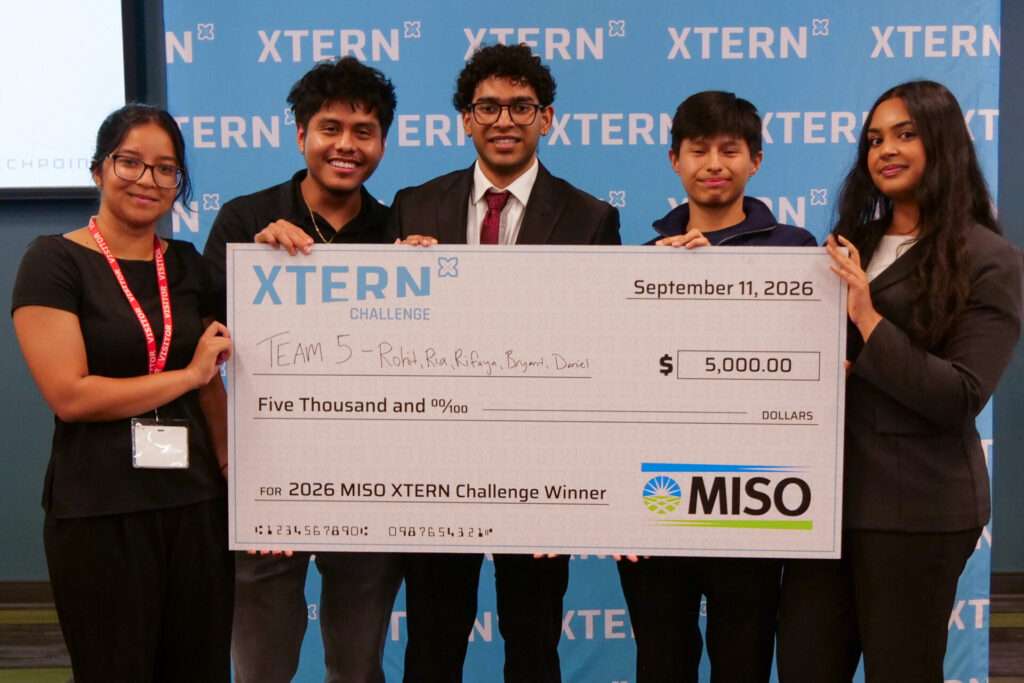
First Place: Team 5 (Prompt 1)
Ria Nimbkar (Purdue University), Bryant Aguirre (University at Buffalo), Rohit Rao (Purdue University), Daniel Riggle (Indiana University Bloomington), Rifaya Riazuddeen (Indiana University Indianapolis)
Team 5 won first place for MISO Bridge, an AI assistant designed to help users explore MISO information through plain-language, source-linked answers.
Team 5 earned first place with MISO Bridge, a personalized AI assistant designed to help users explore MISO information based on their role, experience, region and technical comfort. Users could ask questions in plain language, receive source-linked answers and continue the conversation without repeating context they had already provided.
The team designed the tool around several types of users, including experienced energy professionals, people new to the industry who may be nontechnical, and employees preparing information for colleagues. Team members demonstrated how MISO Bridge could adjust explanations, create charts and schedule recurring updates. During the final presentation, audience members could scan a QR code and participate in the live demonstration.
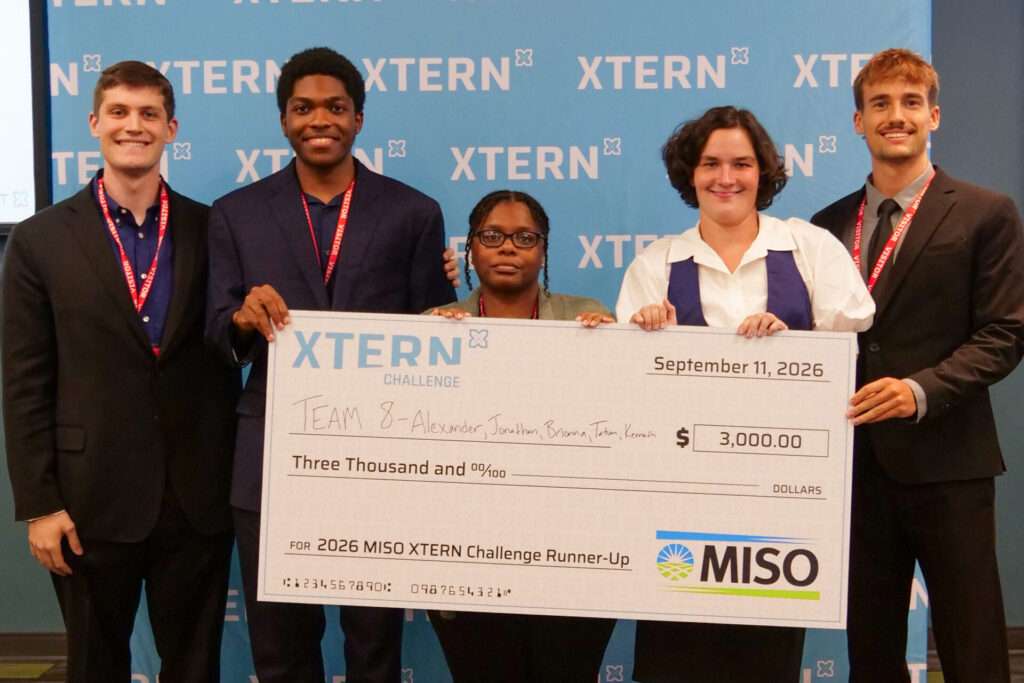
Second Place: Team 8 (Prompt 2)
Alexander Balon (Indiana University Bloomington), Kenneth Enow Jr. (Purdue University), Brionna Morris (Indiana University Indianapolis), Tatum Hadley (Ball State University), Jonathan McCoy (Franklin College)
Team 8 earned second place for its Delivery Assurance Check, designed to help confirm grid infrastructure stays on track ahead of planned increases in large-user electricity demand.
Team 8 took second place with the Delivery Assurance Check, a proposed safeguard for serving large energy users. The proposal would build on MISO’s existing structure, confirming that the necessary grid infrastructure is on track before a planned increase in power use takes effect.
Under the team’s recommendation, MISO would study any full planned increase once, then check the critical assumptions supporting each future increment shortly before it activates. If an infrastructure project has been delayed, MISO could reconsider the planned increase without impacting service that the existing grid can already support. This helps ensure new demand does not outpace the grid’s ability to serve it reliably.
The team supported their recommendation with research into concentrated large-load growth, generator delivery delays and changes to projected transmission in-service dates.
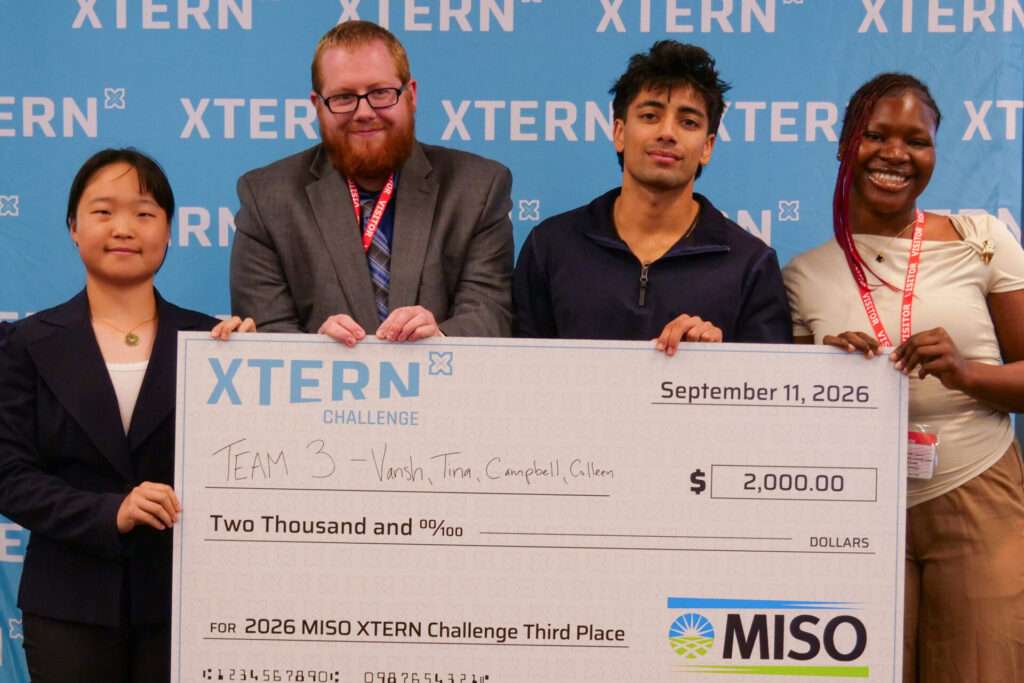
Third Place: Team 3 (Prompt 1)
Colleen Li (Purdue University), Campbell Reed (Ball State University), Vansh Bhardwaj (Texas State University), Inioluwa “Tina” Oyatobo (Indiana University Indianapolis)
Team 3 earned third place for RAMEN, an AI assistant built around approved MISO information with source identification and safeguards against unsupported answers.
Team 3 placed third with RAMEN, an AI assistant designed to help technical and nontechnical users navigate MISO’s public information. The team conducted interviews with MISO employees and built the tool around the needs of market participants, transmission owners, interconnection customers and other groups that use the organization’s data.
RAMEN grounds its responses in MISO’s public APIs and documents, provides sources and timestamps and acknowledges when it does not have enough evidence to answer a question. The design also includes a fallback when an API is unavailable and a process for escalating unresolved information needs. Those guardrails help users find relevant information without sacrificing accuracy or transparency.
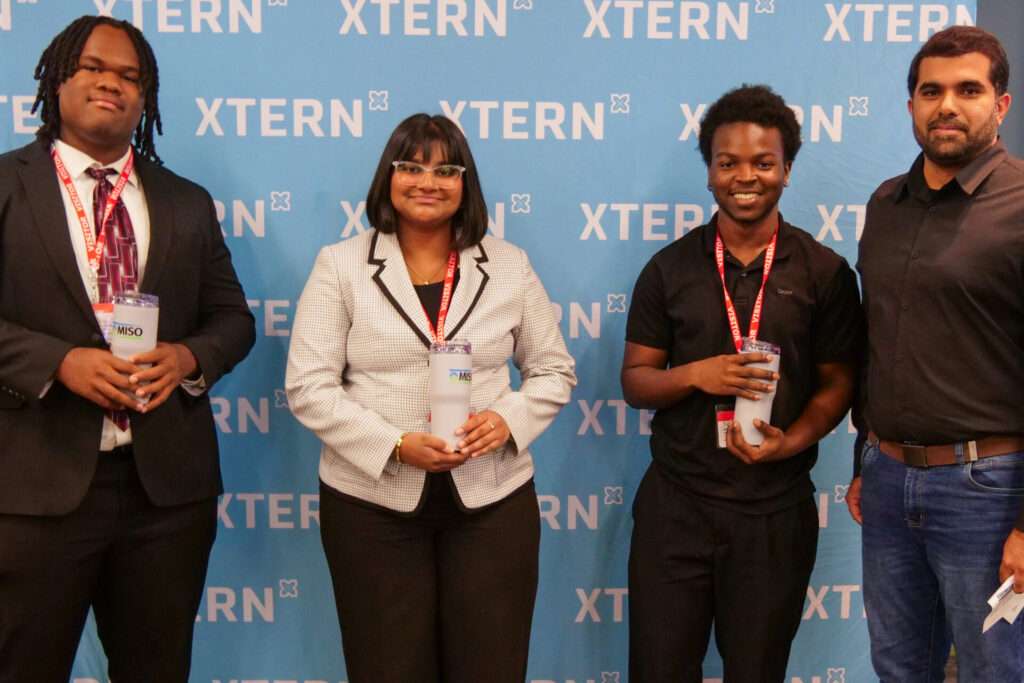
Honorable Mention: Team 4
Kelvin Ohaya (Indiana University Indianapolis), Heer Soni (Indiana University Bloomington), Tavarence Green (Purdue University),
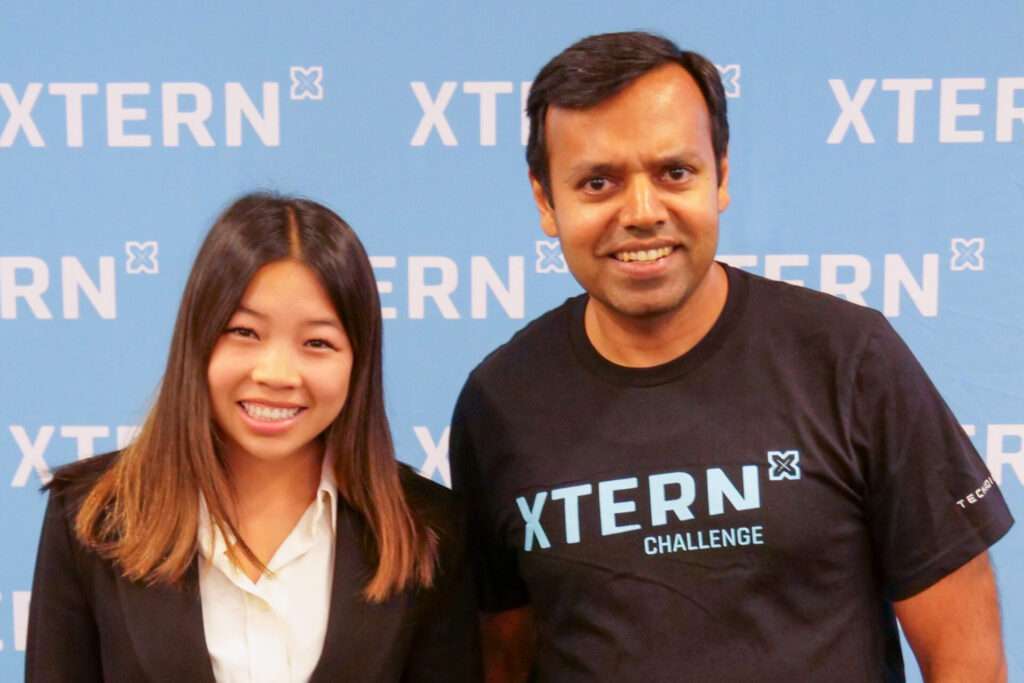
Members of Team 4 pose with Abdul Rahman Mohammed, Senior Director of Data Analytics and Emerging Technologies (right) after being recognized as honorable mention.
Team 4 received an honorable mention for PowerPath, a natural-language assistant designed to support public users, MISO customer service representatives and External Affairs staff. Public users could ask questions without knowing MISO terminology or technical terms, receive explanations supported by official sources and explore suggested follow-up questions.
When PowerPath could not resolve a request, it could create a support ticket containing the user’s conversation, relevant sources and a recommended department. Customer service staff could review earlier questions, track the request and use AI to prepare a draft response for human approval. The team also outlined how the concept could eventually connect with systems including Microsoft Dynamics 365, ServiceNow and Outlook.
MISO Core Values Award
Ava Costanzo, a Purdue University sophomore studying data science and statistics, receives the Xtern Challenge Core Values Award as a member of Team 10. The award was presented by Nirav Shah, Chief Digital and Information Officer at MISO.
MISO recognized Ava Costanzo of Team 10 for exemplifying the company’s core values of integrity, commitment, collaboration, creativity and adaptability throughout the Challenge.
Integrity: We say what we do and do what we say
Commitment: We embrace MISO's mission, vision and goals
Collaboration: We actively seek to understand diverse voices and be inclusive
Creativity: We craft innovative solutions to create value
Adaptability: We are self-motivated and flexible to change as we learn about our industry and profession
Building Experience Before Graduation
Xtern Challenge gives students experience that is difficult to recreate in a classroom. Participants learn to collaborate with teammates from other universities, tackle real business challenges, work directly with industry experts and present recommendations to the people closest to the problem.
MISO employees were active partners throughout the experience, answering questions, sharing expertise and helping students understand complex challenges in the energy industry. That hands-on guidance gave teams the context they needed while leaving them responsible for shaping and defending their own solutions.
The collaboration may continue beyond the event. MISO is exploring ways to further develop two student projects, and many participants are now on track for co-op or internship roles with the organization.
That combination of real work, direct mentorship and career access is what Xtern Challenge is designed to create. Through employer partnerships such as this one, TechPoint connects students with technology careers while giving companies an early look at emerging talent.
Want to participate in the next Xtern Challenge? Join TechPoint's mailing list.
When Mandy Facer arrived at college, she didn’t have a five-year plan. She didn’t know exactly what she wanted to study. She didn’t know what industry she would work in. She didn’t even know what her first job might look like. What she did know was that she loved writing.
"I did not know what I wanted to study when I got to college. I came in knowing I wanted to be a writer, and that's it."
For students who feel pressure to have every detail of their future mapped out, Facer’s story offers a different perspective. Looking back, she realizes that certainty wasn’t what moved her forward. Curiosity was.
Rather than chasing a specific job title, she followed the work that energized her. That decision eventually led her to communications, a field that allowed her to combine storytelling, creativity, strategy, and connection.
What felt like uncertainty at the time would ultimately become an advantage.
An unexpected opportunity
One of the most important moments in Facer’s career began with what she believed was a failed interview. A teaching assistant encouraged her to apply for an editor position at the student newspaper. She wasn’t sure she was qualified, but she applied anyway. But, the job wasn’t in the bag.
"I was a sophomore, and I remember thinking, 'There's no way I got that job.' I felt completely out of my depth. Looking back, it's funny because that opportunity ended up changing the entire trajectory of my career."
She walked away convinced she hadn’t gotten the position, and then the editor called with a job offer. Facer laughs as she still questions how she got that opportunity today, and the experience taught her an important lesson: growth rarely feels comfortable. The very interview she viewed as a failure became the opportunity that launched her career.
Building strong relationships
That job gave Facer newsroom experience. More importantly, it introduced her to mentors who would fundamentally shape the way she approached work. For three years, she worked under an editor named Warren, who challenged her to raise her standards and pay attention to details others overlooked.
"The way that he pushed me gave me an attention to detail that has served me in every job I've had since."
Years later, Facer no longer remembers that experience as a difficult interview or a demanding editor. She remembers it as the first time someone challenged her to operate at a level she didn’t yet know she was capable of reaching. Warren wasn’t simply teaching journalism. He was teaching excellence.
The lesson stayed with her long after graduation and surfaced again in her first professional role, where another mentor took the time to expand her understanding of strategy, audiences, and marketing. While working as a content writer, Facer’s manager routinely stayed after work to share knowledge that accelerated her growth and broadened her view of what a communications career could become.
“Every day after work, we’d clock out at five, and he would sit there and whiteboard for me how to do marketing strategies, how to understand audiences, how to build out segments,” Facer said. “He just poured all of this knowledge into me.”
Those experiences helped shape a belief she carries today: success is rarely a solo endeavor. Behind most successful careers are people who took the time to teach, challenge, encourage, and invest in someone else’s growth.
Using stories to create opportunity
Today, Facer serves as Director of Journalism and Digital Strategy at Lumina Foundation, where she helps tell stories that influence conversations around education, workforce development, and opportunity. The role draws on nearly every skill she has developed throughout her career, from journalism and communications to marketing and digital strategy. But what excites her most isn’t the title—it’s the impact.
"One of the things I love most about my role is that I get to help elevate stories that might not otherwise be heard. We're constantly looking for ways to bring attention to student populations that are underserved and create greater awareness around the opportunities that can change lives."
For Facer, storytelling is about communication, but it’s also about helping people see possibilities for themselves.
The real soft skills
People often assume successful communicators are exceptional writers or public speakers. Facer believes the most important skill is something else entirely.
"Ultimately, the number one skill I use every day is listening. People often think communication starts when you begin talking, but I've found it starts much earlier than that. Before I can build a strategy, tell a story, or craft a message, I need to understand the people I'm trying to reach. I don't know what I'm going to say until I've taken the time to listen."
It’s a lesson that applies far beyond communications. Whether you’re building relationships, exploring careers, or leading teams, understanding people starts with listening.
A career still being written
Outside of work, Facer is pursuing a Master of Fine Arts in Creative Writing at Butler University and continues to write poetry. In many ways, she has come full circle: The student who arrived at college knowing only that she wanted to write has built an entire career around the power of stories.
Looking back, Facer doesn’t see a perfectly planned journey. She sees a series of opportunities, mentors, and moments that helped her grow into a career she couldn’t have imagined when she first stepped onto a college campus. Today, she continues to give back by mentoring former team members and colleagues, connecting them to opportunities and advising them to follow their own paths.
“I believe the biggest thank you I can give to the people who have invested so much in me is to open new doors for the people I am lucky enough to meet and work with,” says Facer.
For students wondering whether they have everything figured out, that’s exactly the point. You don’t have to. Sometimes all you need is the courage to follow what interests you and the willingness to say yes before you feel completely ready.
When most people hear life sciences, they picture doctors, nurses, or scientists in white lab coats. They’re only seeing part of the picture. Behind every new medicine, medical device, diagnostic test, or breakthrough treatment is an entire workforce of people solving problems, building products, analyzing data, managing supply chains, operating advanced manufacturing facilities, developing software, and ensuring quality at every step.
That’s what makes Indiana’s life sciences industry one of the state’s most exciting career destinations.
Whether you’re interested in biology, engineering, technology, business, logistics, communications, or advanced manufacturing, there’s a good chance your skills have a place in life sciences.
Indiana is quietly leading one of America's fastest-growing industries
Indiana isn’t just participating in the life sciences economy. In many ways, it’s helping shape it. The state ranks No. 1 in the nation for both life sciences exports and pharmaceutical exports, supporting more than 70,000 life sciences jobs across 3,300+ companies and organizations. The average annual wage in the industry is approximately $177,000, reflecting the specialized skills these careers require. It’s also an industry that continues to grow.
Companies are investing billions of dollars in new facilities, expanding advanced manufacturing, accelerating biotechnology research, and using artificial intelligence to transform the discovery and production of medicines.
More than scientists
One of the biggest misconceptions about life sciences is that every job requires becoming a physician or research scientist. In reality, it takes thousands of professionals with different backgrounds to move a single product from discovery to the patient.
That includes careers in:
Advanced manufacturing
Engineering
Automation and robots
Quality assurance and quality control
Information technology and cybersecurity
Data analytics and artificial intelligence
Sales and customer support
Supply chain and logistics
Project management
Regulatory affairs
Human resources
Finance and accounting
Marketing and communications
Ask ten people in Indiana’s life sciences industry how they got their start, and you’ll likely hear ten different stories. Some began with advanced degrees. Others found their way through technical education, internships, apprenticeships, or entry-level roles that grew over time. What many careers have in common isn’t where they started; it’s how they continue to grow.
Companies you've heard of - and many you haven't
Indiana is home to globally recognized employers, including Eli Lilly and Company, Roche Diagnostics, Cook Medical, Zimmer Biomet, Elanco, and an expanding network of biotechnology, radiopharmaceutical, diagnostics, and medical device companies. Together, they form one of the country’s most diverse life sciences ecosystems.
That diversity also means careers look very different from one company to the next. Some employees spend their days developing breakthrough medicines. Others maintain automated manufacturing systems, manage production schedules, analyze laboratory data, improve quality systems, or use artificial intelligence to solve complex problems. Their work may look different, but every role plays a part in bringing new ideas, technologies, and medicines from concept to patient.
Your first job doesn't have to be your forever job
One of the reasons life sciences appeals to so many early-career professionals is the opportunity to keep growing. Industries evolve, technologies change, new medicines are developed, and companies expand. But the skills you build in one role often open doors to another. That’s exactly what professionals like Andrea Faberlle-Diaz discovered.
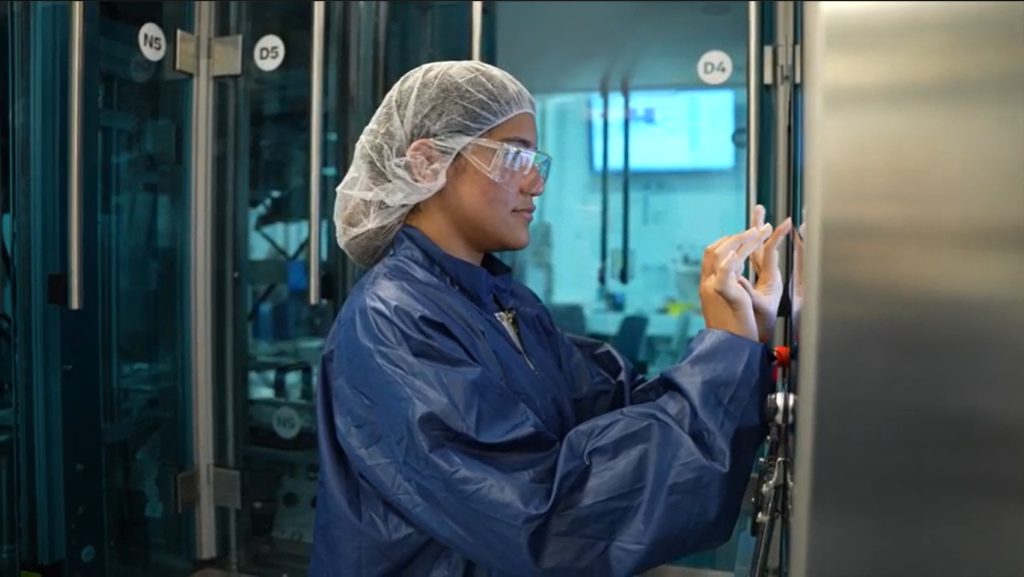
She entered college knowing she loved science but unsure what career she wanted. A required internship introduced her to pharmaceutical manufacturing, and one conversation at a career fair eventually led her from Puerto Rico to Indiana, where she now supports advanced manufacturing operations at Eli Lilly.
Her story isn’t unusual. Many professionals in Indiana’s life sciences industry didn’t start with a detailed career blueprint. They started by exploring opportunities, asking questions, and gaining experience.
Start exploring now
Few people begin their careers with all of the answers. More often, they begin with a conversation at a career fair, an internship, a classroom project, or someone willing to show them what’s possible. Indiana’s life sciences industry is no different.
Whether your interests lean toward science, technology, engineering, advanced manufacturing, business, data, or problem-solving, there’s a place for people with different skills and different perspectives. The hardest part isn’t choosing your entire career today; it’s simply taking the first step to explore what’s possible.
Andrea Faberlle-Diaz walked up to the Eli Lilly career fair booth expecting to talk about opportunities down the street from her college. As graduation approached at the University of Puerto Rico, she was exploring what came next. Eli Lilly had a facility on the island, and after spending months in a pharmaceutical manufacturing internship, it seemed like the natural place to start the conversation. Instead, the recruiter pointed her in a direction she hadn’t considered.
Indiana.
“I was interested in the Puerto Rico facility,” Andrea recalled. “But after talking about my experience, they told me I would actually be a much better fit in Indiana because the injectables side was expanding so much.”
That one conversation and that one unexpected suggestion led to a decision that would change the course of her career.
Today, Andrea works in Indiana’s life sciences industry, supporting pharmaceutical manufacturing at Eli Lilly, where she helps produce medicines that reach patients worldwide. Looking back, she realizes that opportunity wasn’t something she could have planned for. It was something she discovered by staying curious enough to explore what was in front of her.
She didn't have her whole plan mapped out - just the next step
Andrea is quick to admit she wasn’t one of those students who always knew exactly what they wanted to do.
"If you had asked me after high school, I really had no idea what I wanted to do career-wise. The next step was college. I figured I'd decide what I wanted to do once I got there."
She was clear on two things: she loved science, and she likely wouldn’t pursue an engineering path.
“Unfortunately, I’m not good at math,” she said with a laugh. “I wasn’t then, and I’m not now.”
Biology felt like the right fit, so she enrolled at the University of Puerto Rico and focused on what was immediately ahead rather than trying to map out the next decade. Ironically, it was one assignment she hadn’t been looking forward to that would give her the clarity she was searching for.
The internship that changed everything
Like many college programs, Andrea’s degree required students to complete industry experience before graduating – and finding that opportunity was entirely up to her. At the time, it felt intimidating: identifying a company, applying for a role, and immersing herself in the organization. Looking back, she describes that experience as a turning point.
"Finding my own industry experience forced me to think differently. Instead of just trying to get through classes, I started asking myself, 'What do I need to do to become the ideal candidate?' It made me more intentional about everything – from my biology and chemistry courses to gaining as much lab experience as I could."
She landed an internship in pharmaceutical manufacturing expecting it to be another step toward graduation. Instead, it became the experience that reshaped her career. What was supposed to be a two-month internship stretched into six.
“The internship was originally supposed to be from June to July, but I stayed until December,” she says. “Each day I found myself challenged by a new problem to solve. I remember how excited I was to be gaining new experiences so early in my career. I already knew I was passionate about working in manufacturing and working with operators; that experience just confirmed it.”
Until then, science had largely existed in textbooks, lectures, and labs. On the manufacturing floor, she saw something different. Every process, every quality check, and every person on the line contributed to something far bigger than a classroom assignment. She wasn’t just studying biology anymore; she was helping manufacture medicines that would one day reach patients around the world.
The resource that helped shape her career
That internship eventually led her back to the career fair and to the conversation that brought her to Indiana. The move meant leaving home, starting over, and joining one of the world’s largest pharmaceutical companies during a period of rapid expansion. It also meant stepping into an industry that refuses to stand still.
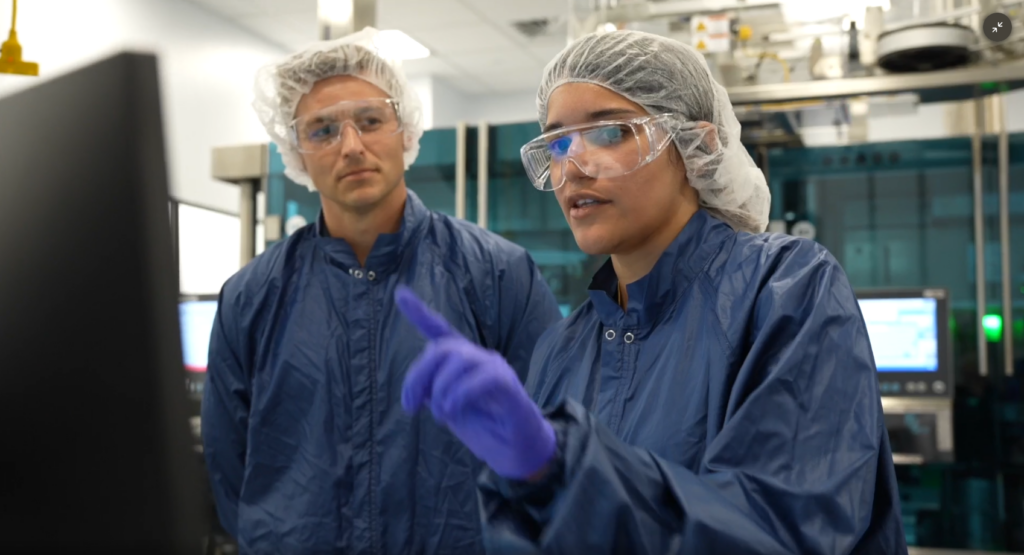
Today, Andrea works as an Operations Associate, supporting manufacturing operations that run around the clock. She helps troubleshoot production challenges, supports operators across the manufacturing floor, and helps teammates continue developing their own careers.
“I spend a lot of time supporting our operators,” she said. “Whether it’s helping someone work through a challenge or preparing them for new opportunities, it’s rewarding to see people grow in their careers.”
It’s a role that demands technical knowledge, collaboration, and a willingness to keep learning. Fortunately, that’s exactly what Andrea enjoys most.
"One of the things I love most is that the work never feels stagnant. The technology keeps evolving, the teams keep growing, and every day you're learning from someone or something new. There's really no limit to what you can learn."
A front-row seat to innovation
For Andrea, one of the biggest draws of the industry is that it never stands still.
“I think what excites me the most is just the rate at which discovery is happening,” she said. “There are so many incredible things happening and so many life-changing medicines being developed.”
That pace extends beyond the manufacturing floor. Advances in artificial intelligence are beginning to reshape how new medicines are discovered, opening possibilities that seemed unimaginable just a few years ago.
“Now, with the application of AI in drug discovery, the potential just keeps growing,” she said. “This is such an exciting industry to be in because the possibilities really feel endless.”
For someone who enjoys learning, it’s exactly the kind of environment she was hoping to find.
Just take the next step
Looking back, Andrea doesn’t think the most important decision she made was choosing the right major or finding the perfect first job. It was staying open to opportunities she hadn’t expected.
“My number one piece of advice is don’t be afraid to try new things,” she said. “Always prepare. Always show up. But don’t be afraid if you’re not the most prepared or the most confident person in the room. Just give anything a try.”
She pauses before sharing the lesson that’s stayed with her throughout college, her internship, and the move to Indiana.
"Everyone talks about the bigger picture and planning out what you want to be in the end. Sometimes, in some stages, just knowing your next step is enough."
That’s exactly how Andrea’s career unfolded. She couldn’t have predicted where her curiosity would lead. A required internship became a career. A conversation at a recruiting booth became a move to Indiana. And a willingness to keep taking the next step led her to an industry where learning never stops. Sometimes, that’s all it takes.
For many students, one question looms larger than almost any other: “What do I want to do after graduation?”
For Emily Britton, the answer didn’t arrive overnight.
Today, Britton works as a Business Development Representative for Cheneco, helping organizations across Indiana evaluate solar and battery storage solutions. She enjoys the work, loves meeting people, and has found a career that aligns with her strengths.
But getting there required something many students struggle to give themselves: time.
“I always knew I was going to college,” Britton said. “What I didn’t know was what I wanted my career to be.”
Looking back, Britton says some of the most valuable lessons she learned had little to do with choosing the perfect major and everything to do with learning about herself.
5 Pieces of Advice to Find a Career you Love
1. Take your time
Like many college students, Britton felt pressure to determine exactly what she wanted to do after graduation. But after receiving a job offer before graduation, she made a decision that surprised some people: she didn’t immediately accept it. Instead, she spent time exploring her options and working with Purdue University’s career services team to better understand her strengths, interests, and professional goals.
"I think it's so important to take your time when career searching because you want to find something that you're passionate about."
That patience ultimately led her to a role she genuinely enjoys.
2. Build relationships early
If there’s one piece of advice Britton gives students consistently, it’s simple: Network.
Whether through LinkedIn, industry events, career fairs, student organizations, or informational interviews, she believes relationships can open doors that applications alone often cannot.
“Your network is everything,” Britton said.
She encourages students to reach out to professionals whose careers interest them, ask questions, and learn about industries they may not have considered. Many professionals, she says, are more willing to help than students realize.
“I guarantee you there’s going to be someone willing to have a conversation with you,” she said.
3. Stay curious
One of Britton’s favorite parts of her job is learning about industries and careers she never knew existed. Through networking events, facility tours, conferences, and client meetings, she has discovered just how many opportunities exist beyond the careers students typically hear about in school.
"I've learned that there are so many jobs out there that I never knew existed."
That curiosity has become one of her greatest professional strengths. Instead of focusing only on job titles, she encourages students to learn about industries, ask questions, and remain open to unexpected opportunities.
4. Focus on your strengths
Britton’s career path also reinforced the importance of understanding what energizes you. For her, the answer was clear: She enjoys building relationships, communicating with others, and learning people’s stories.
Those strengths naturally aligned with business development, even though she didn’t initially plan to pursue a career in sales or business strategy.
“I love people,” Britton said. “I love talking to people. I love building relationships.”
Rather than searching for a job title first, she encourages students to identify the activities they genuinely enjoy and then explore careers that allow them to use those strengths every day.
5. Remember that career paths aren't linear
Britton began college studying kinesiology before eventually transitioning into marketing. Today, she works in Indiana’s energy sector. Her journey serves as a reminder that careers rarely follow a perfectly straight line.
The skills students develop in college—communication, critical thinking, collaboration, and problem-solving—often prove just as valuable as the specific major listed on a diploma.
"A lot of people study one thing and end up taking a completely different career path."
For students who feel uncertain about their future, she hopes that realization provides reassurance. Not knowing exactly where you’re headed doesn’t mean you’re behind. Sometimes it simply means you’re still discovering the path that’s right for you.
The biggest lesson
If there’s one message Britton hopes students take away from her experience, it’s that everyone’s journey looks different. Some people find their dream career immediately. Others need time to explore, experiment, and adjust their plans along the way. Both paths are valid.
“Everyone’s journey is different,” Britton said. “It can look so many different ways.”
For Britton, that journey led to a career she loves, a growing professional network, and opportunities she never imagined when she first arrived on Purdue’s campus.
And it all started with being willing to keep exploring.
When Emily Britton graduated from Purdue University, she didn’t have a five-year plan.
What she did have was a willingness to explore, ask questions, and take her time finding the right fit.
Today, Britton is a Business Development Representative for Cheneco, helping organizations across Indiana evaluate renewable energy solutions that can lower costs and improve operational efficiency. She spends her days building relationships, solving problems, and learning about industries that power Indiana’s economy.
But getting there wasn’t a straight line.
"I always knew I was going to college. What I didn't know was what I wanted my career to be."
Emily’s future uncertainty ultimately became one of her greatest advantages, leading her to opportunities she never expected and a career she now loves in Indiana’s advanced industries sector.
But, her path to Indiana’s energy industry wasn’t one she mapped out in high school. Like many students, she discovered her career direction through exploration, curiosity, and a willingness to change course along the way.
Finding her path at Purdue
Like many young Hoosiers, Emily Britton imagined her future would take her beyond state lines.
“I always thought that once I graduated college, I was going to leave Indiana and try something new,” she said.
Instead, a career she never expected—and a professional network she never anticipated building—gave her reasons to stay.
"I feel very lucky to enjoy my job. And, the network I've built in Indiana has really made me love where I live for an entirely different reason."
When it came time to choose a college, Britton focused primarily on Indiana universities. After touring several campuses, she ultimately chose Purdue University. At the time, she believed her future might be in healthcare.
“I always enjoyed math. I always enjoyed anatomy,” Britton said. “I thought maybe I would be a chiropractor.”
She began her college career studying kinesiology, but as she learned more about herself and the opportunities available to her, she realized another path might be a better fit.
Why changing directions can be a good thing
After arriving at Purdue, Britton transitioned from kinesiology into marketing through the Daniels School of Business. The shift gave her exposure to disciplines far beyond marketing alone, including statistics, accounting, and business strategy.
At first, she questioned why so much of her coursework extended beyond her major, but looking back, she sees it differently.
"I realized they were preparing us for the world. A lot of people study one thing and end up going in a different direction."
That realization would prove true in her own career journey.
While she graduated with a marketing degree, the skills she developed would ultimately help prepare her for a role centered on communication, relationship-building, business strategy, and problem-solving.
The resource that helped shape her career
After graduation, Britton made a decision many new graduates might find uncomfortable: she slowed down.
Although she received a job offer before graduation, she chose not to accept it immediately. Instead, she wanted time to determine what type of work would truly align with her interests and strengths.
During that process, she leaned heavily on Purdue’s career services team.
Working with a career counselor, she completed personality assessments, explored career options, refined her resume, and gained clarity about what she wanted from her professional future.
“I knew that I really wanted to do something that I would enjoy,” she said. “But that approach means that there are a million different opportunities to consider. I appreciated having an on-campus resource to help me prepare for my career path more purposefully.”
The experience reinforced a lesson she now shares with students whenever she can.
"I think it's so important to take your time when career searching because you want to find something that you're passionate about. You're going to succeed if you're passionate about it."
Discovering opportunity in Indiana's energy industry
While Britton didn’t originally envision herself working in energy, she has found both purpose and opportunity in the industry.
She enjoys helping organizations explore renewable energy solutions while learning about the industries that power Indiana’s economy.
Through her work, she regularly visits manufacturers, healthcare organizations, and businesses across the state.
“I love continuously learning about the world and how things are made,” she said.
The experience has also opened her eyes to the scale of Indiana’s advanced industries.
From manufacturing hubs in Columbus and Lafayette to growing investments across the state, Britton sees Indiana as a place where innovation and industry continue to create opportunities for young professionals.
“There is so much industry in the state of Indiana,” she said. “And it’s continuously growing.”
Emily's advice for students exploring their future
When students ask how to find a career they enjoy, Britton’s answer often comes back to one word: connection.
She encourages students to use LinkedIn, attend industry events, speak with professionals, and take advantage of career resources available through their schools and universities.
Most importantly, she encourages them not to panic if they don’t have everything figured out.
Career paths rarely follow a straight line.
Some students discover their passion immediately. Others need time to explore, experiment, and learn more about themselves.
“Everyone’s journey is different,” Britton said. “It can look so many different ways.”
For Britton, that journey began with uncertainty about what came after college. Through exploration, networking, and a willingness to embrace unexpected opportunities, she found a career she loves—and a future she never expected to build in Indiana.
This article was written by Janiya Beason, communications intern for CICP.
Internships offer students more than workplace experience—they provide opportunities to develop new skills, build professional relationships, and explore potential career paths. This summer, four interns joined the CEOs of Indiana Corporate Partnership (CICP) and its initiatives, contributing to projects that support Indiana’s advanced industries while gaining valuable real-world experience.
Hands-On Experience
From communications and marketing to business analysis and AI, each intern had the opportunity to contribute to projects with real impact this summer.
Janiya Beason, Communications Intern for CICP and a TechPoint Xtern, helped launch the See Yourself IN TikTok account, created a website feedback survey to gather user insights and opinions, contributed to a media kit, and collaborated on content and social media ideas.
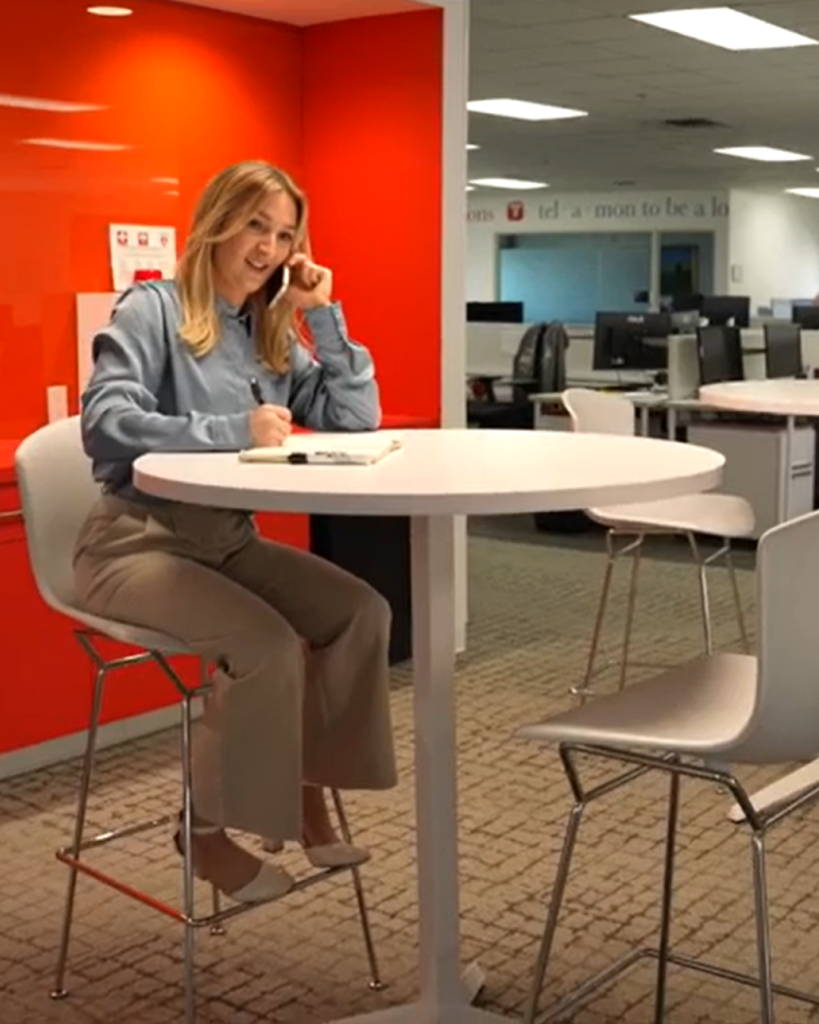
Camila Garcia, Marketing Xtern for TechPoint, managed Instagram, LinkedIn, and YouTube content, created blog posts for the Xtern program, and interviewed Mira Awards finalists to help tell the stories of Indiana’s growing technology ecosystem.
Reflecting on her experience, Camila said one of the most rewarding aspects of the internship was the opportunity to work with many different platforms and audiences.
“I’ve learned how to adjust my voice and format depending on the platform and audience, which has been one of the most valuable parts of the experience.”
Gianna Bird, Business Analyst Intern for CICP, she supported outreach and logistics for the Indiana AI (IN AI) Roadshow while analyzing AI readiness among businesses across Indiana.
Krish Gajaria, AI Strategy and Innovation Intern at AgriNovus Indiana, focused on developing an AI implementation strategy to improve everyday operations, researching workforce development, and supporting the Velocity startup accelerator. One of the highlights of his internship was presenting AgriNovus’s AI strategy during a board meeting.
“Having the opportunity to share my thoughts and insights with a group of people coming from a myriad of different backgrounds was an incredibly valuable and formative experience that further reinforced my belief in the importance of communication.”
Together, these projects gave each intern the opportunity to make meaningful contributions while gaining hands-on experience in Indiana’s advanced industries.
Growing Professional Skills
Beyond their day-to-day responsibilities, each intern developed technical and professional skills that will prepare them well for future careers.
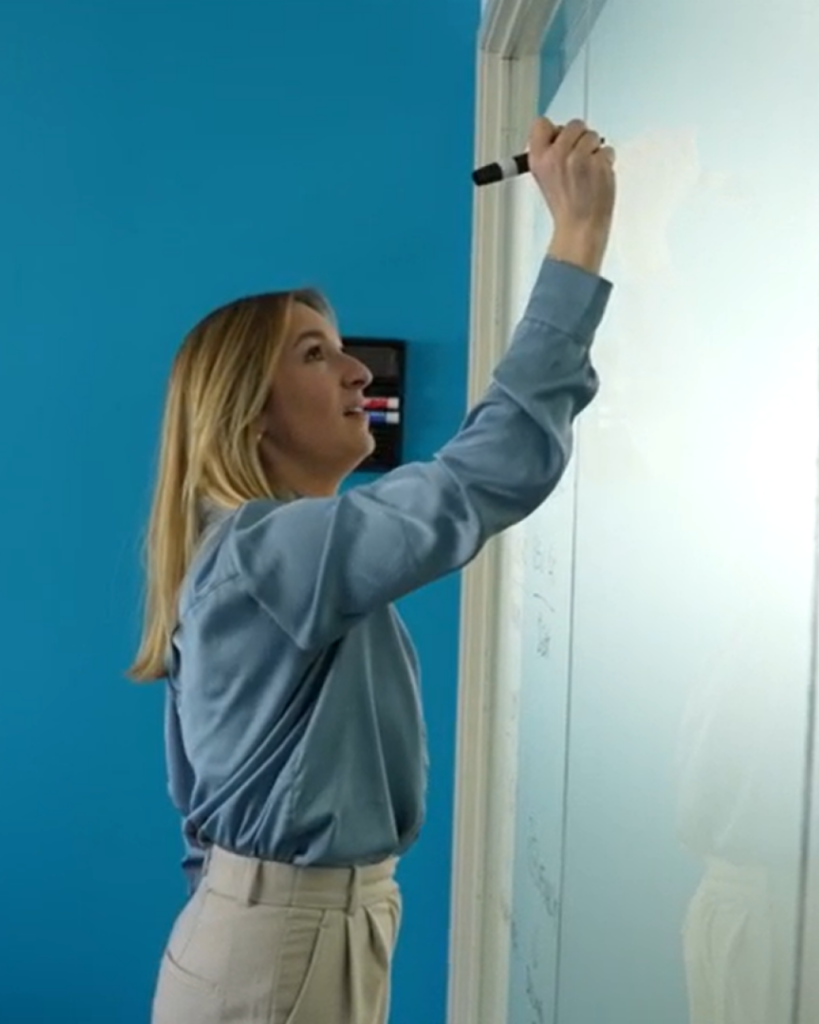
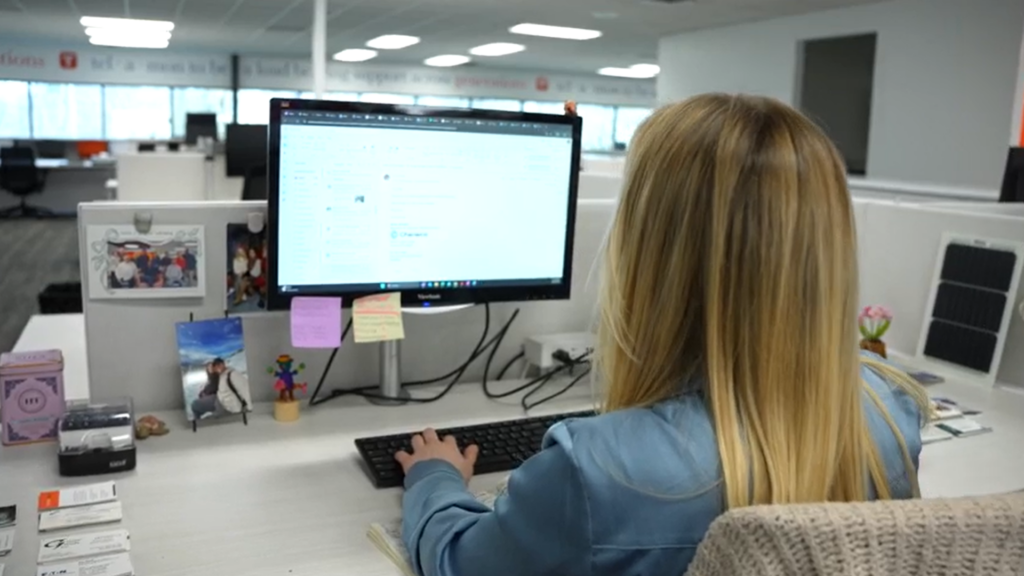
Camila expanded her digital marketing skillset by learning WordPress and writing SEO metadata for website content.
Janiya strengthened her collaborative skills while taking initiative and offering ideas in meetings, as well as researching how to connect and engage different audiences through content.
“One skill I’ve gained was giving my input and researching how we can reach different ages and audiences. Working in communications, I feel it’s important to know your target audience and how to engage them.”
Gianna built confidence through networking and connecting with professionals while promoting the IN AI initiative.
“This got me out of my comfort zone and talking with people I had never met before.”
For Krish, one of the biggest lessons was learning that effective communication is just as important as technical knowledge.
“Knowing how something works is one thing, but being able to break it down and share your knowledge with others is a whole new ball game.”
Looking Ahead
While each intern worked on different projects throughout the summer, the experience helped each of them gain a clearer vision for their future careers.
Camila hopes to use storytelling to help brands and organizations connect with diverse audiences through meaningful content.
“Marketing lets me shape how a story gets told, and international studies reminds me that the same story lands differently depending on the audience and culture. I love figuring out how to bridge that gap.”
Janiya looks forward to creating engaging content that reaches wider audiences and hopes to continue finding various ways to grab attention through content. She hopes one day to manage social media for major brands.
“What excites me the most is coming up with creative content that could reach a wider audience, and finding different ways to engage people. I also hope to possibly manage social media for big brands!”
Gianna says working at CICP showed her the value of a collaborative workplace where teammates celebrate one another’s successes.
For Krish, the internship reinforced his passion for applying business and technology across industries to solve meaningful challenges.
“I’m excited about the diversity. To me, business and economics are less about isolated fields of study and more about bringing new perspectives that can be applied across disciplines.”
As another successful summer comes to a close, these internships have provided students with more than just professional experience—they’ve offered opportunities to learn, grow, and make meaningful contributions to organizations shaping Indiana’s future. Through hands-on projects, mentorship, and collaboration, CICP continues to invest in the next generation of talent while helping students build the skills, confidence, and connections they’ll carry throughout their careers.
This article was originally published by Field Atlas. Click here to read the original article.
AgriNovus Indiana launched its second year of the Field Atlas Agbioscience Mentorship Program (AMP) in February – and the desire students have to make a difference in the world through careers in agbioscience, mixed with the dedication industry leaders have to supporting our next generation workforce through this program, has been invaluable.
AMP is a guided yearlong mentorship program that connects late college students and early professionals to industry leaders excelling in the agbioscience field. This year, 16 students were paired with industry leaders who serve as their mentors for the duration of the program. Current mentees include juniors in college to PhD students from universities such as Purdue, Ball State, Indiana University, Butler and more. These students come from various backgrounds and areas of study, all with the hopes of developing their professional skills and ultimately learning how they can utilize those skills to create a meaningful impact in agbioscience.
The selected 2026 cohort includes students pursuing degrees in Animal Science, Biology, Chemistry, Biological Engineering, Environmental Management, and more. Many of the students in this cohort do not come from an agricultural background but have recognized the importance of agriculture and its effects on our food system through AMP and other Field Atlas programs. Through the guidance of their mentors, they have become inspired to seek new opportunities and gain insight into how their specific background and skills align with career paths in this space.
Every month, each mentor and mentee pair meet to discuss various professional development topics and how mentees can best prepare to enter the workforce. The conversations had in the first few months of the program showcase just how valuable mentorship can be (see below):
“The most helpful aspect of this session was the discussion on interpersonal communication and how it is shaped by cultural context. My mentor emphasized the importance of active listening, understanding what is considered appropriate and professional in interactions, and adapting communication styles in different professional environments… A key takeaway for me was that while many factors are external, the most important element I can control is how I communicate and present myself.” — AMP mentee
“This month I was able to understand that sometimes weaknesses are not totally weaknesses, especially if they help you actually strategically and tactically achieve goals.” — AMP Mentee
“I got more exposure to the industry, developed plans for researching the industry and got experience with imagining how my major could apply to companies.” — AMP Mentee
“The most helpful part of this session was discussing my professional goals and how my diverse background from crop science and agricultural field experience to my current PhD research in functional genomics and bioinformatics positions me as a unique candidate for roles in the agbioscience industry. My mentor provided valuable insight into how this combination of academic, field, and research experience can be an advantage in the industry. He also offered to help connect me with professionals in the field and create networking opportunities that could further support my career development.” — AMP Mentee
“I found it especially helpful that my mentor shared a wide range of resources to support my research project. Learning more about current trends and the available sources he can offer has been very valuable.” — AMP Mentee
AMP would not be possible without industry leaders dedicated to serving and guiding our next generation workforce. It is inspiring for young professionals to have an established leader to look up to and learn from. We are thankful for every single mentor who has contributed their time and knowledge to the mentees and the Agbioscience Mentorship Program. It is evident how much of an impact they are creating for these students as they embark on their professional journeys.
Are you interested in joining the 2027 Agbioscience Mentorship Program as a mentor or mentee? Reach out to Career Success Manager, Karis Witte ([email protected]).
We’ve all heard those stories about engineers who started out as little junior engineers. When they were kids, they were always building things with Legos or tinkering with machines.
Braxton Bragg says that wasn’t him.
The future Product Innovation Engineer with Evansville’s Berry Global was more into sports.
As he got older, though, the foundation for a career in engineering took shape. At New Albany High School, along with participating in athletics, Braxton found that chemistry, physics and math interested him, and that he wasn’t half bad at those subjects. His junior and senior years, he took a job working on a farm and discovered that the mechanics of the tractors and other equipment fascinated him. As these factors pulled together, he recognized where his path was leading. When he headed off to college at the University of Southern Indiana, he majored in engineering.
And when an opportunity for an internship at Berry Global came up during his sophomore year, Braxton jumped on it. He was familiar with the plastic container and product company, but didn’t know much about its operations. What he learned hooked him in a hurry.
“I was blown away by how much goes into making a plastic drinking cup or plastic lid or the container that holds your products in the grocery,” Braxton says. “The kind of technical crew it takes to pull off efficient production of something like that, it took me for a shock.”
Hired on as a full-time employee in 2019 and promoted to his current position in 2020, Braxton says he enjoys being a part of the company’s global headquarters because that gives him a front-row seat to everything from product ideation to seeing items he worked on come off the production line. He currently has five or six projects on which he serves as project manager, he says, all in different stages. He enjoys the variety of the work and the fact that every day can be a little different.
He also enjoys the constant drive to make better products more efficiently. “Coming up with a better way to make a better widget that nobody else can make, that’s always the process,” Braxton says. “Innovation as a whole is consistent on the product and process side.”
And he’s delighted to have landed a job with all those features just a short drive from his hometown. Married to his high school sweetheart, Braxton enjoys staying in touch with friends and family and taking advantage of Southern Indiana’s hunting and fishing options. And while engineering ultimately took up a larger part of his life than the sports that he focused on as a kid, he hasn’t given up athletics completely. He’s taken up running, and he’s preparing to run his second marathon.


 Camila expanded her digital marketing skillset by learning WordPress and writing SEO metadata for website content.
 Gianna built confidence through networking and connecting with professionals while promoting the IN AI initiative.