TechPoint selected 50 college students from 135 applicants for its latest Xtern Challenge, a work-based learning competition hosted in partnership with MISO at the company’s Carmel headquarters September 10 and 11.
The event marked TechPoint’s second Xtern Challenge with MISO, building on the partners’ first competition in 2025.
After more than two weeks of remote collaboration, 10 teams composed of students from 14 universities came together for two days of mentorship, career exploration and final presentations. Students worked on real business challenges facing MISO and the energy industry while meeting the company’s hiring managers and executives.
MISO (Midcontinent Independent System Operator) manages the electric grid across the central United States and helps ensure reliable power for 45 million people. Its team operates the grid, manages an energy market and plans for the industry’s future through technology and research. The Xtern Challenge gave students an opportunity to see how that work happens while demonstrating their technical, analytical and communication skills.
“What I really see students getting out of this program is not just learning about our industry and our problems, but learning how to interact as professionals and be part of a professional environment, interacting with our leaders, our subject matter experts, our analysts and data scientists so not only can they see a future career path but they also learn valuable skills they can take forward into any future career.”
Two Challenges Facing the Energy Industry
Together, MISO and TechPoint developed two prompts for the competition. The first, Intelligent Navigation of MISO’s Public Information, asked students to build an AI tool that could make public data on MISO’s website easier to find, understand and use. Teams needed to serve users with different levels of technical experience while reducing routine information requests handled by MISO’s customer service and External Affairs teams.
The second prompt, Large Loads, focused on the rapid growth of major energy users across MISO’s footprint. Teams analyzed a synthetic dataset showing rising electricity use, researched the energy industry and recommended how MISO could respond while preserving grid reliability.
“I gained a lot of skills through XTERN Challenge. Not just technical skills but also soft skills like working with a team of students from different universities. Just working together and coming up with something great. Having to present it together, coordination, and time management.”
An Inside Look at MISO
The in-person experience began on Thursday with a welcome from MISO and a final question-and-answer session on the prompts. Students then spent much of the first day refining their projects with MISO mentors available on site. They also toured the headquarters and participated in networking sessions with managers from across the company, giving them time to learn about MISO’s work and potential career paths.
Day two opened with an executive breakfast and panel. Each team then completed a full practice session and technology check before presenting to MISO judges, internship hiring managers and company executives. The format gave students experience explaining complex work to both technical experts and business leaders, an important skill in any technology career.
MISO said many of this year’s participants are already progressing toward internship or co-op roles with the company. That recruiting connection made the Challenge more than a case competition. Students could demonstrate how they collaborate, respond to feedback and communicate under pressure before applying those skills in a workplace.
“Programs like XTERN Challenge are a perfect opportunity for students to gain the skills that employers are looking for today. AI has changed the game in terms of technical skill and requirements. What’s more important are the durable skills like communication, teamwork, project management, working together, working in a new place, having timelines, and that’s exactly what programs like XTERN Challenge do, and why we’re so excited to partner with MISO to make this a reality.”
Results and Recognition
After all 10 teams presented, MISO judges recognized first-, second- and third-place teams, an honorable mention and one student who exemplified the company’s core values. Students on the top three teams received cash prizes.
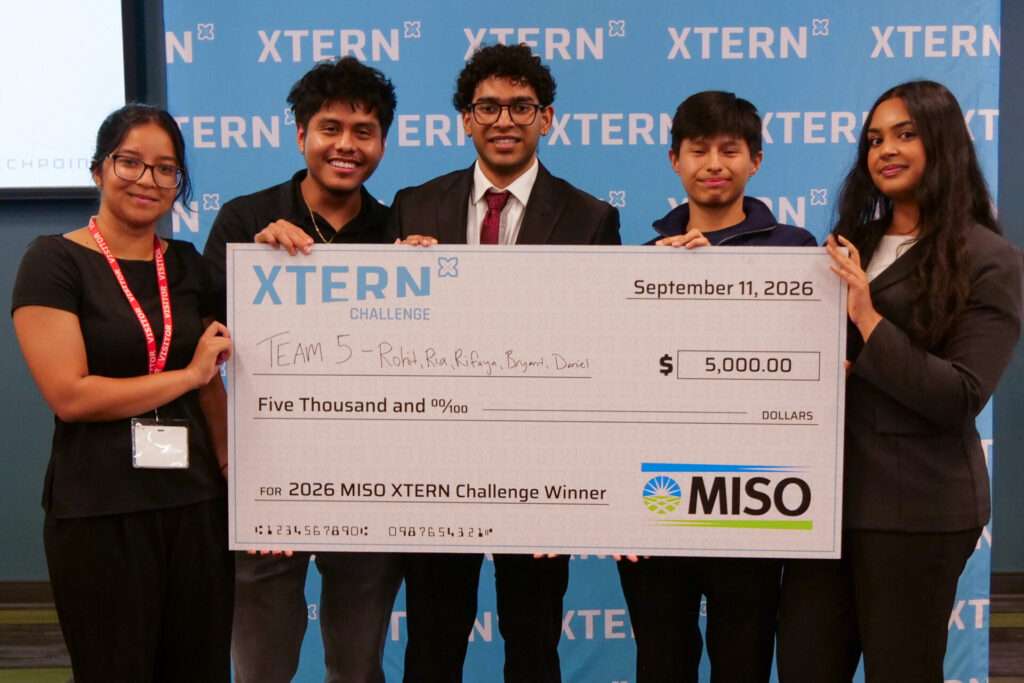
First Place: Team 5 (Prompt 1)
Ria Nimbkar (Purdue University), Bryant Aguirre (University at Buffalo), Rohit Rao (Purdue University), Daniel Riggle (Indiana University Bloomington), Rifaya Riazuddeen (Indiana University Indianapolis)
Team 5 won first place for MISO Bridge, an AI assistant designed to help users explore MISO information through plain-language, source-linked answers.
Team 5 earned first place with MISO Bridge, a personalized AI assistant designed to help users explore MISO information based on their role, experience, region and technical comfort. Users could ask questions in plain language, receive source-linked answers and continue the conversation without repeating context they had already provided.
The team designed the tool around several types of users, including experienced energy professionals, people new to the industry who may be nontechnical, and employees preparing information for colleagues. Team members demonstrated how MISO Bridge could adjust explanations, create charts and schedule recurring updates. During the final presentation, audience members could scan a QR code and participate in the live demonstration.
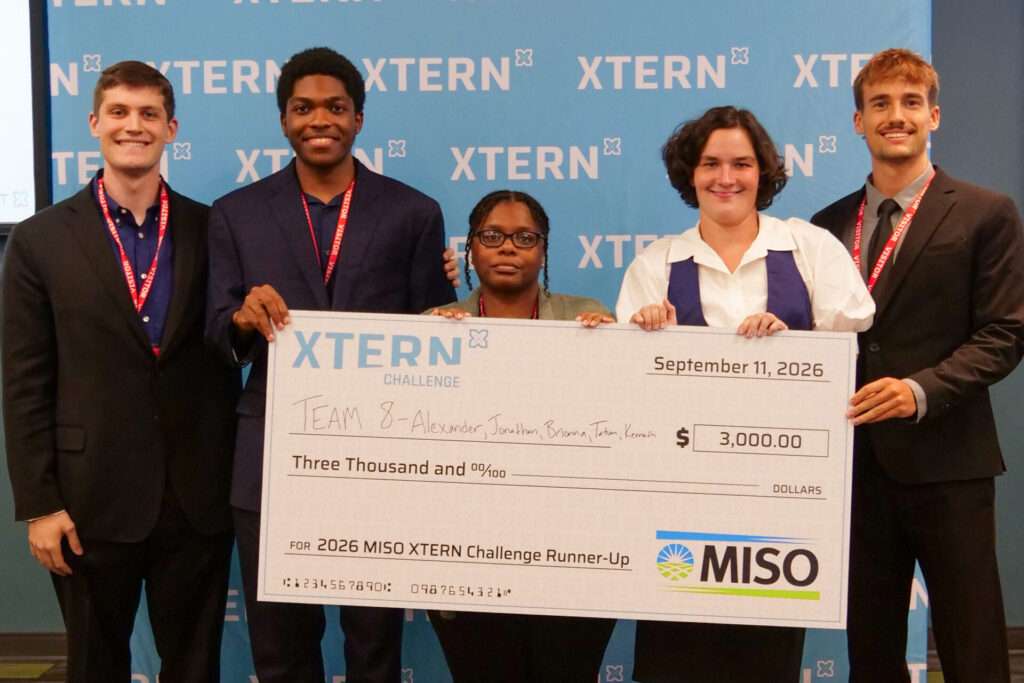
Second Place: Team 8 (Prompt 2)
Alexander Balon (Indiana University Bloomington), Kenneth Enow Jr. (Purdue University), Brionna Morris (Indiana University Indianapolis), Tatum Hadley (Ball State University), Jonathan McCoy (Franklin College)
Team 8 earned second place for its Delivery Assurance Check, designed to help confirm grid infrastructure stays on track ahead of planned increases in large-user electricity demand.
Team 8 took second place with the Delivery Assurance Check, a proposed safeguard for serving large energy users. The proposal would build on MISO’s existing structure, confirming that the necessary grid infrastructure is on track before a planned increase in power use takes effect.
Under the team’s recommendation, MISO would study any full planned increase once, then check the critical assumptions supporting each future increment shortly before it activates. If an infrastructure project has been delayed, MISO could reconsider the planned increase without impacting service that the existing grid can already support. This helps ensure new demand does not outpace the grid’s ability to serve it reliably.
The team supported their recommendation with research into concentrated large-load growth, generator delivery delays and changes to projected transmission in-service dates.
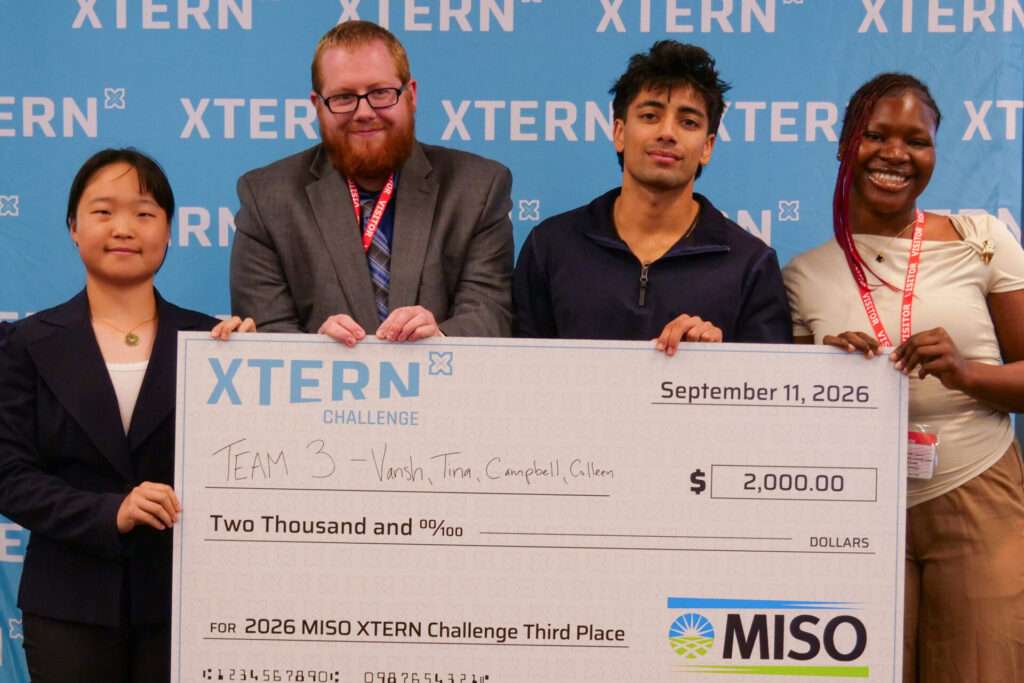
Third Place: Team 3 (Prompt 1)
Colleen Li (Purdue University), Campbell Reed (Ball State University), Vansh Bhardwaj (Texas State University), Inioluwa “Tina” Oyatobo (Indiana University Indianapolis)
Team 3 earned third place for RAMEN, an AI assistant built around approved MISO information with source identification and safeguards against unsupported answers.
Team 3 placed third with RAMEN, an AI assistant designed to help technical and nontechnical users navigate MISO’s public information. The team conducted interviews with MISO employees and built the tool around the needs of market participants, transmission owners, interconnection customers and other groups that use the organization’s data.
RAMEN grounds its responses in MISO’s public APIs and documents, provides sources and timestamps and acknowledges when it does not have enough evidence to answer a question. The design also includes a fallback when an API is unavailable and a process for escalating unresolved information needs. Those guardrails help users find relevant information without sacrificing accuracy or transparency.
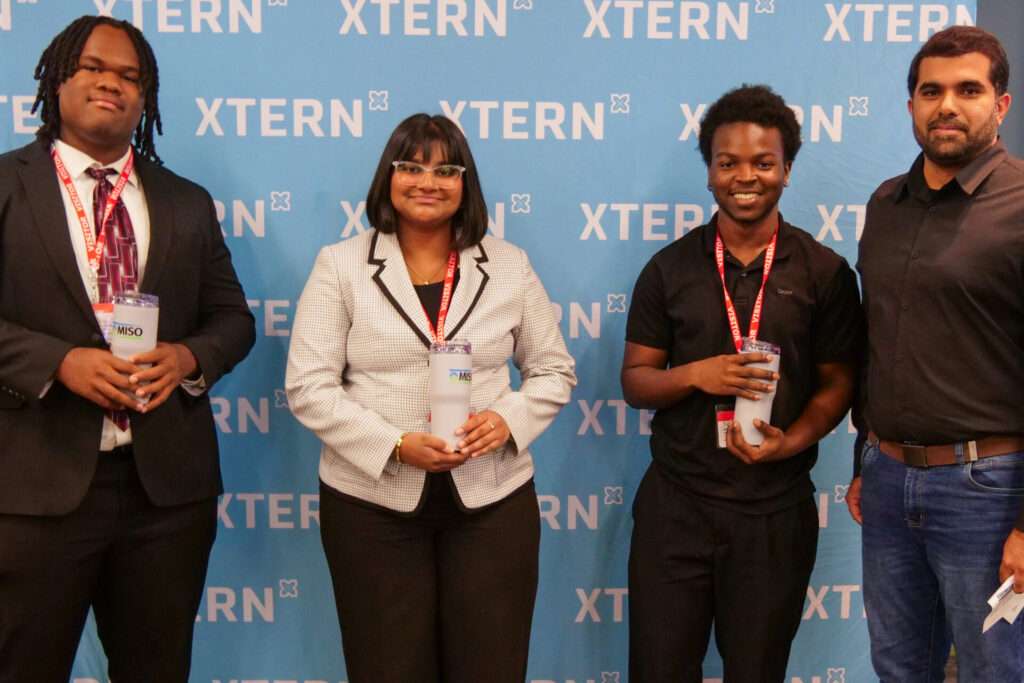
Honorable Mention: Team 4
Kelvin Ohaya (Indiana University Indianapolis), Heer Soni (Indiana University Bloomington), Tavarence Green (Purdue University),
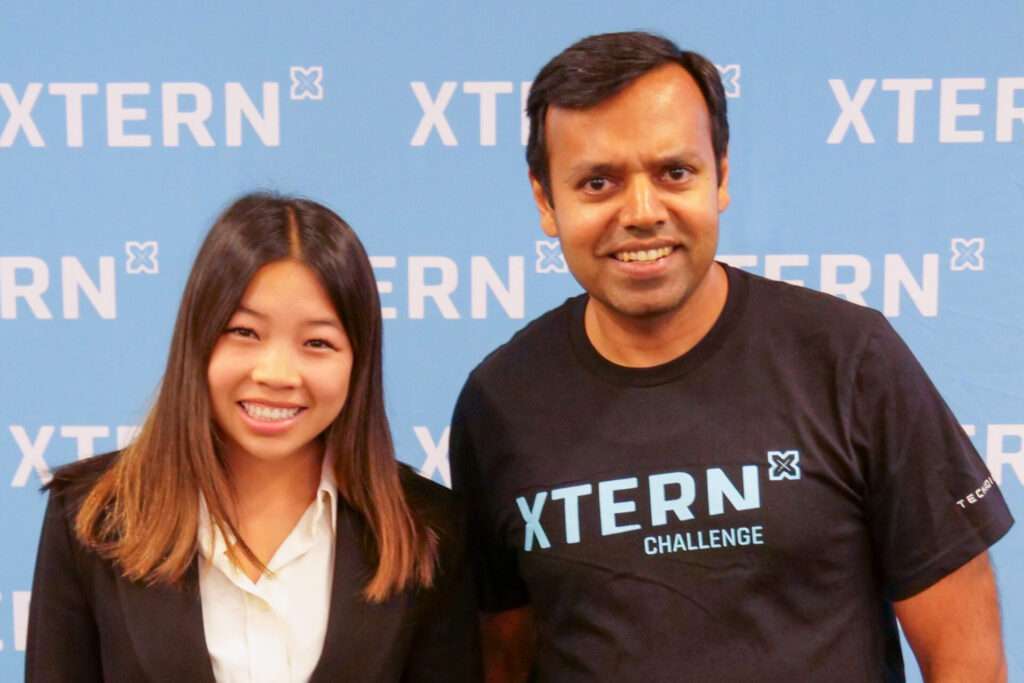
Members of Team 4 pose with Abdul Rahman Mohammed, Senior Director of Data Analytics and Emerging Technologies (right) after being recognized as honorable mention.
Team 4 received an honorable mention for PowerPath, a natural-language assistant designed to support public users, MISO customer service representatives and External Affairs staff. Public users could ask questions without knowing MISO terminology or technical terms, receive explanations supported by official sources and explore suggested follow-up questions.
When PowerPath could not resolve a request, it could create a support ticket containing the user’s conversation, relevant sources and a recommended department. Customer service staff could review earlier questions, track the request and use AI to prepare a draft response for human approval. The team also outlined how the concept could eventually connect with systems including Microsoft Dynamics 365, ServiceNow and Outlook.
MISO Core Values Award
Ava Costanzo, a Purdue University sophomore studying data science and statistics, receives the Xtern Challenge Core Values Award as a member of Team 10. The award was presented by Nirav Shah, Chief Digital and Information Officer at MISO.
MISO recognized Ava Costanzo of Team 10 for exemplifying the company’s core values of integrity, commitment, collaboration, creativity and adaptability throughout the Challenge.
Integrity: We say what we do and do what we say
Commitment: We embrace MISO's mission, vision and goals
Collaboration: We actively seek to understand diverse voices and be inclusive
Creativity: We craft innovative solutions to create value
Adaptability: We are self-motivated and flexible to change as we learn about our industry and profession
Building Experience Before Graduation
Xtern Challenge gives students experience that is difficult to recreate in a classroom. Participants learn to collaborate with teammates from other universities, tackle real business challenges, work directly with industry experts and present recommendations to the people closest to the problem.
MISO employees were active partners throughout the experience, answering questions, sharing expertise and helping students understand complex challenges in the energy industry. That hands-on guidance gave teams the context they needed while leaving them responsible for shaping and defending their own solutions.
The collaboration may continue beyond the event. MISO is exploring ways to further develop two student projects, and many participants are now on track for co-op or internship roles with the organization.
That combination of real work, direct mentorship and career access is what Xtern Challenge is designed to create. Through employer partnerships such as this one, TechPoint connects students with technology careers while giving companies an early look at emerging talent.
Want to participate in the next Xtern Challenge? Join TechPoint's mailing list.
This article was written by Janiya Beason, communications intern for CICP.
Internships offer students more than workplace experience—they provide opportunities to develop new skills, build professional relationships, and explore potential career paths. This summer, four interns joined the CEOs of Indiana Corporate Partnership (CICP) and its initiatives, contributing to projects that support Indiana’s advanced industries while gaining valuable real-world experience.
Hands-On Experience
From communications and marketing to business analysis and AI, each intern had the opportunity to contribute to projects with real impact this summer.
Janiya Beason, Communications Intern for CICP and a TechPoint Xtern, helped launch the See Yourself IN TikTok account, created a website feedback survey to gather user insights and opinions, contributed to a media kit, and collaborated on content and social media ideas.
Camila Garcia, Marketing Xtern for TechPoint, managed Instagram, LinkedIn, and YouTube content, created blog posts for the Xtern program, and interviewed Mira Awards finalists to help tell the stories of Indiana’s growing technology ecosystem.
Reflecting on her experience, Camila said one of the most rewarding aspects of the internship was the opportunity to work with many different platforms and audiences.
“I’ve learned how to adjust my voice and format depending on the platform and audience, which has been one of the most valuable parts of the experience.”
Gianna Bird, Business Analyst Intern for CICP, she supported outreach and logistics for the Indiana AI (IN AI) Roadshow while analyzing AI readiness among businesses across Indiana.
Krish Gajaria, AI Strategy and Innovation Intern at AgriNovus Indiana, focused on developing an AI implementation strategy to improve everyday operations, researching workforce development, and supporting the Velocity startup accelerator. One of the highlights of his internship was presenting AgriNovus’s AI strategy during a board meeting.
“Having the opportunity to share my thoughts and insights with a group of people coming from a myriad of different backgrounds was an incredibly valuable and formative experience that further reinforced my belief in the importance of communication.”
Together, these projects gave each intern the opportunity to make meaningful contributions while gaining hands-on experience in Indiana’s advanced industries.
Growing Professional Skills
Beyond their day-to-day responsibilities, each intern developed technical and professional skills that will prepare them well for future careers.
Camila expanded her digital marketing skillset by learning WordPress and writing SEO metadata for website content.
Janiya strengthened her collaborative skills while taking initiative and offering ideas in meetings, as well as researching how to connect and engage different audiences through content.
“One skill I’ve gained was giving my input and researching how we can reach different ages and audiences. Working in communications, I feel it’s important to know your target audience and how to engage them.”
Gianna built confidence through networking and connecting with professionals while promoting the IN AI initiative.
“This got me out of my comfort zone and talking with people I had never met before.”
For Krish, one of the biggest lessons was learning that effective communication is just as important as technical knowledge.
“Knowing how something works is one thing, but being able to break it down and share your knowledge with others is a whole new ball game.”
Looking Ahead
While each intern worked on different projects throughout the summer, the experience helped each of them gain a clearer vision for their future careers.
Camila hopes to use storytelling to help brands and organizations connect with diverse audiences through meaningful content.
“Marketing lets me shape how a story gets told, and international studies reminds me that the same story lands differently depending on the audience and culture. I love figuring out how to bridge that gap.”
Janiya looks forward to creating engaging content that reaches wider audiences and hopes to continue finding various ways to grab attention through content. She hopes one day to manage social media for major brands.
“What excites me the most is coming up with creative content that could reach a wider audience, and finding different ways to engage people. I also hope to possibly manage social media for big brands!”
Gianna says working at CICP showed her the value of a collaborative workplace where teammates celebrate one another’s successes.
For Krish, the internship reinforced his passion for applying business and technology across industries to solve meaningful challenges.
“I’m excited about the diversity. To me, business and economics are less about isolated fields of study and more about bringing new perspectives that can be applied across disciplines.”
As another successful summer comes to a close, these internships have provided students with more than just professional experience—they’ve offered opportunities to learn, grow, and make meaningful contributions to organizations shaping Indiana’s future. Through hands-on projects, mentorship, and collaboration, CICP continues to invest in the next generation of talent while helping students build the skills, confidence, and connections they’ll carry throughout their careers.
This article was originally published by TechPoint. Click here to read the original article.
On June 26, Xterns gathered for their second programming weekend of the summer, this time at Republic Airways in Carmel, IN. IndyHackers and a group of former Xterns joined the cohort for a full day centered on AI and the ever-changing workforce.
Welcome Remarks
The morning began with remarks from Matt Belanger, Vice President of Information Technology and Chief Information Officer at Republic Airways, who welcomed Xterns into the space and spoke to the importance of interns and the work they contribute. He even gave a shout-out to Republic’s own Xtern, Samuel Ortner.
Today’s AI: We’ve Seen This All Before, and Will Again
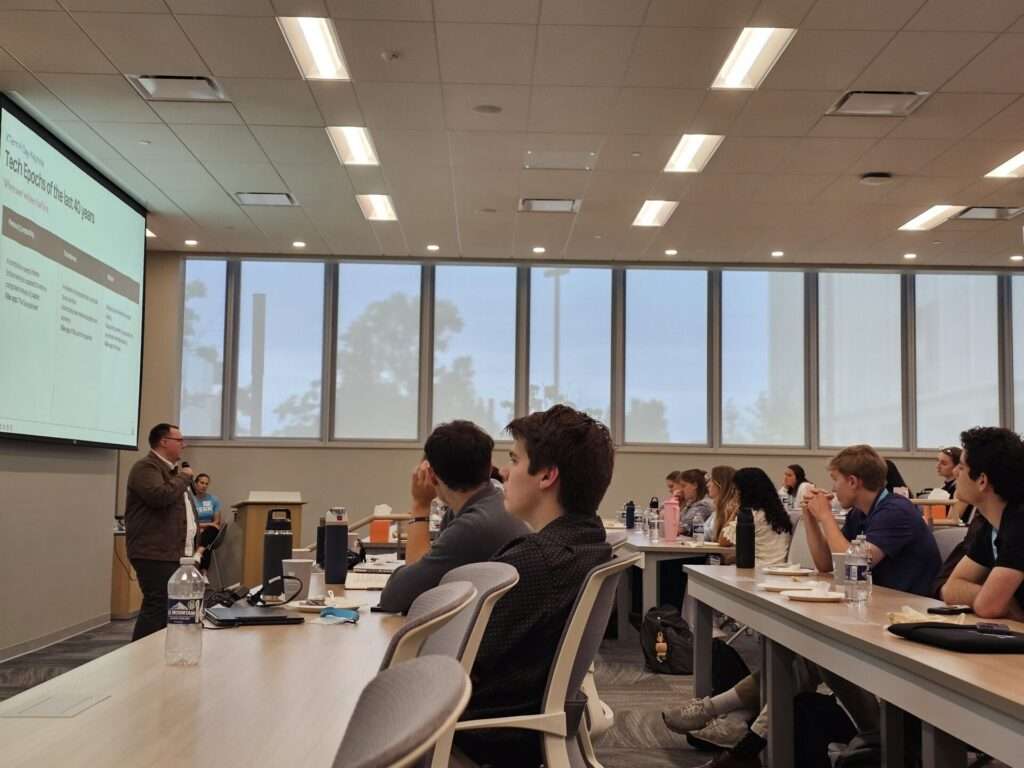
Chris Vannoy, President of IndyHackers, delivered the morning’s keynote, built around one central idea: we’ve seen this before. He pointed to three previous technology cycles over the past 40 years: personal computing, the internet and mobile phones. He pointed out that each reshaped how we live and work by moving through the same three stages: boom, bust and absorption.
Chris Vannoy leads the Xtern AI Day keynote, “Tech Epochs of the Last 40 Years,” walking Xterns through four decades of major technology shifts ahead of a deeper look at artificial intelligence.
Vannoy defined the boom as the moment money starts flowing and experimentation runs wild, the bust as the point where that money comes due and clear winners and losers emerge, and absorption as the stage where the technology finally becomes mainstream and fades into the background of everyday life. In his view, AI is currently in its “boom baby” phase, with much of its potential still being discovered. “No one knows for certain where this is headed. I have theories, but only because I’ve lived through this before,” he told the group.
He also pointed to the opportunity AI presents for Gen Z specifically, noting that companies are already subsidizing employees’ use of AI tools. His advice: play around, experiment and have fun learning and growing alongside the technology.
AI & Skill Change Panel
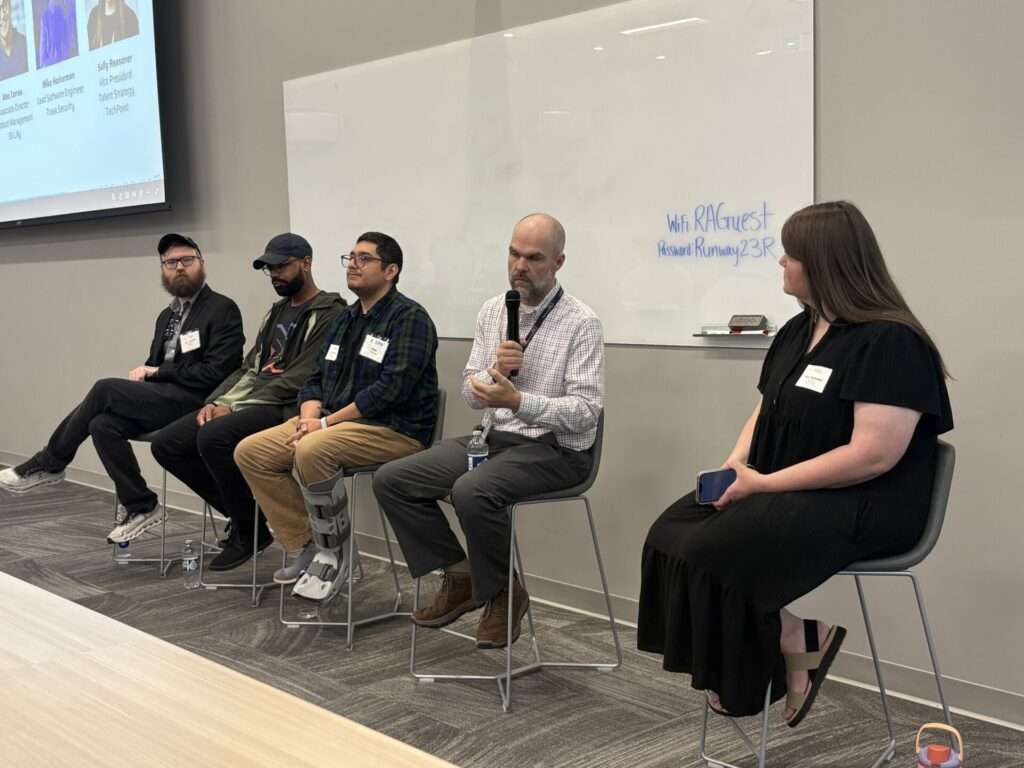
Following the keynote, Sally Reasoner, VP of Talent Strategy, moderated a panel featuring Mike Hocherman (Trava Security), Tylor Garret (Sense), Alex Correa (Eli Lilly), and Daniel Shickell (Republic Airways). Notably, Tylor, Alex and Mike were all members of the very first Xtern cohort.
Mike Hockerman of Trava Security, Tylor Garret of Sense, Alex Correa of Eli Lilly, and Daniel Shickell of Republic Airways joined TechPoint’s Sally Reasoner (left to right) for a panel focused on AI and skill changes panel.
Reasoner asked the panelists about their use of AI tools day-to-day and how their expectations compared to reality. Across the board, the consensus was similar: AI is useful for a lot of things, but it can’t replicate the emotion and connection that only humans bring to the table.
Correa emphasized the importance of getting comfortable with AI now, since every career path will eventually intersect with it. Whether that means streamlining a workflow or getting help revising an email. When the conversation turned to job interviews, the panelists were unanimous: don’t let AI tell your story. Personal projects and experiences that don’t show up on a resume tend to generate real excitement in an interview, and that’s worth leaning into. Hocherman added that personal, human questions resonate far more than anything AI-generated ever could, so let your enthusiasm show.
While using AI early in your career is almost expected at this point, Correa encouraged Xterns to also seek out a mentor, someone who can teach the things AI simply can’t. Shickell agreed, adding that as AI continues to advance, human connection and the ability to have a real conversation will only become more valuable. Still, staying curious and continuing to experiment with AI matters. As one panelist put it, human skills won’t be replaced, because humans are intelligent and resilient – so don’t be afraid to use the tools available.
AI Workshops
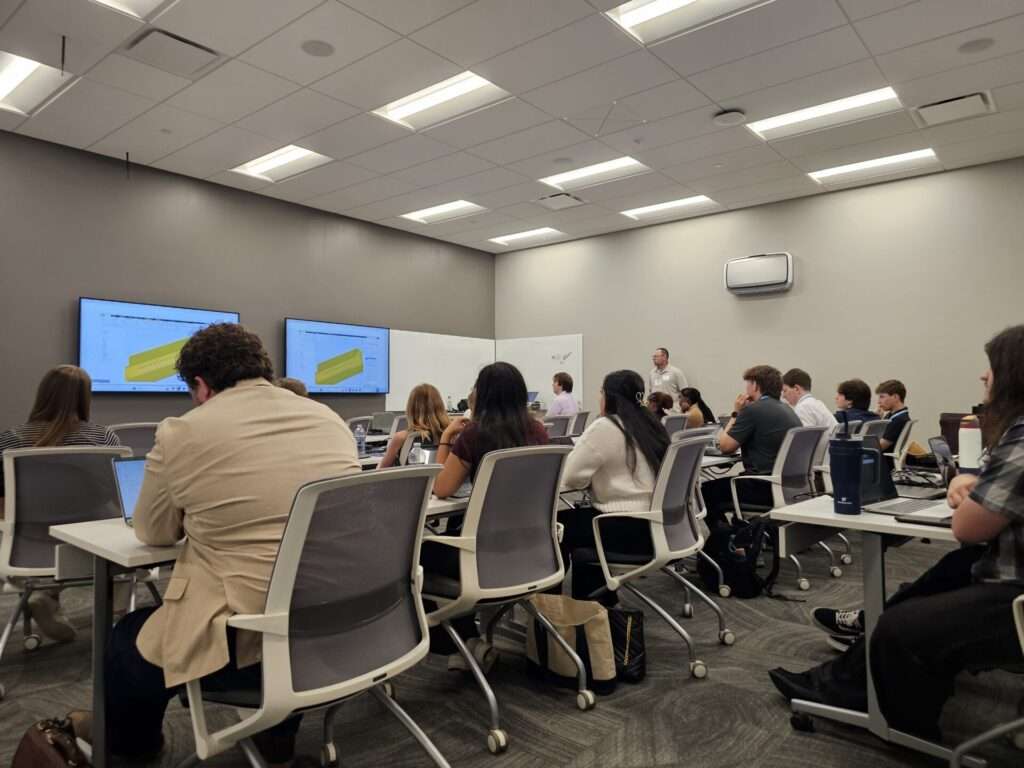
Xterns then broke into one of three workshops: AI Safety, AI for Business and Marketing Professionals, or AI in CAD. Each session explored how AI is being applied within a specific field, introduced different AI tools, and underscored the importance of using AI safely and responsibly. Students left the workshops ready to share what they learned and put those tools into practice.
Xterns work through a hands-on 3D modeling exercise during an engineering workshop session at summer programming.
The AI Safety workshop dug into the rapid rise of agentic engineering in software development over the past six months. It covered both the advantages and pitfalls of AI-generated code – including cost – and how to strengthen an agentic toolchain with better guardrails and auditability. The session also walked through how Skills, Agents and Servers function within Claude Code and Codex, along with practical tips for setting AI on autopilot, and introduced Statewright.ai, an agentic harness designed to close some of the current gaps in agentic engineering software development lifecycles
The AI for Business and Marketing Professionals workshop looked at how generative AI has reshaped marketing and sales from the ground up. Content marketing has had to adapt to a landscape flooded with undifferentiated AI-generated content, all while search engine traffic has dropped significantly. At the same time, new startups are emerging daily with AI-driven bots and avatars aimed at replacing SDRs and BDRs. The session examined how the industry is adjusting to this new reality – which tools are rising to the top, how the day-to-day work is changing, and which skills matter now more than ever.
The AI in CAD workshop explored how AI is being built into PTC’s Creo Parametric software through three stages of maturity: Advise, Assist, and Automate. Creo Advise acts as a chatbot for engineering support, while Creo Assist works directly with a user’s model to validate designs, check compliance, and surface insights. Looking ahead, Creo Automate, expected in late 2026 or early 2027, will use historical CAD data and manufacturing standards to suggest and optimize designs automatically through multi-agent orchestration via the Model Context Protocol (MCP).
Closing Remarks
Sally Reasoner closed out the afternoon by looking ahead to upcoming events, including Community Connect on Friday, July 24, at the NCAA Hall of Champions in Indianapolis from 9 am to 1 pm.
Current Xterns who still need to register, or who want to register a project to present, can do so here. Community members interested in joining TechPoint at Community Connect can learn more and register at techpoint.org/communityconnect.
This article was originally published by TechPoint. Click here to read the original article.
On June 5, TechPoint welcomed the 2026 Xtern cohort for its first programming weekend of the summer at the Dallara Experience Hub in Speedway. Throughout the day, Xterns participated in professional development workshops, peer networking activities, industry discussions and workplace readiness sessions designed to help them make the most of their summer internships.
Welcoming Remarks from TechPoint CEO and President
The morning began with remarks from TechPoint’s CEO and president, Eric Christopher, who shared his journey growing up in Richmond, IN as the son of a blue-collar worker to becoming a first-generation student at Indiana University, co-founding Zylo, and ultimately leading TechPoint.
Reflecting on his experiences as a builder and entrepreneur, Eric spoke about the value of creating opportunities through technology and the impact that innovation can have on Indiana’s economy. He emphasized that technology enables individuals to not only build successful businesses but also to create jobs and lasting value within their communities.
When asked about Gen Z’s greatest strengths and challenges, he pointed to artificial intelligence as both. While AI presents opportunities for innovation and growth, he noted that gaining meaningful work experience remains one of the biggest hurdles for recent graduates.
“Xtern is built to give you that,” he told attendees.
Understanding Indiana’s Industry Landscape
Sally Reasoner, vice president of talent strategy at TechPoint, provided an overview of Indiana’s evolving technology and innovation landscape while sharing the history of the Xtern program.
Launched in 2014 with just five participating companies, Xtern was created to help employers address recruitment challenges by showcasing not only career opportunities, but also the advantages of living and working in Indiana.
Over the past 13 years, the program has expanded far beyond its original focus on software development. Today Xtern opportunities span industries including engineering, marketing, healthcare, manufacturing, finance and aviation.
Industry Leaders Discuss the Future of AI
A panel featuring industry leaders Mike Cronin (SEP), Scott Sobczak (V2X), Kristi Steppe (IU Health), and Troy Kelley (E-gineering Inc.) explored the growing role of artificial intelligence within their respective industries.
The discussion addressed both the opportunities and responsibilities that come with AI adoption. Panelist shared perspectives on how AI is improving efficiency, supporting decision-making and helping organizations better serve customers and communities.
Cronin addressed concerns about AI replacing technical talent, noting that the demand for developers continues to remain strong. Steppe highlighted how AI is helping healthcare organizations reduce harm events through enhanced monitoring and support systems.
When discussing responsible AI use, panelists emphasized several key themes: protecting sensitive information, maintaining ethical accountability, and ensuring that technology enhances, not replaces, human creativity and judgement.
A recurring message throughout the discussion was the importance of continuous learning.
“Don’t be afraid to jump into the unknown as long as you’re willing to learn,” Sobczak advised.
Navigating the Human Side of Work
Andi Hines-Logemann of Elevate Ventures led a session focused on managing stress and micro-stress while transitioning into the workforce.
She encouraged Xterns to view confidence as a skill that can be developed over time rather than as a fixed trait. One of the sessions central messages was that curiosity is more valuable than perfection, especially early in a career.
As interns navigate new responsibilities and unfamiliar environments, Hines-Logemann reminded attendees that employers do not expect them to know everything. Instead, asking thoughtful questions and demonstrating a willingness to learn are often the strongest indicators of future success.
Body Working – Listening with Your Eyes
Mitch Isaacs of Shafer Leadership Academy introduced Xterns to the role body language plays in professional interactions and networking.
Describing body language as “an outward reflection of inward reality,” Isaacs challenged participants to think about how their posture, presence, and nonverbal cues influence the way others perceive the. He encouraged attended to adopt a balance approach- confident and approachable without appearing overly closed or overly assertive.
The session concluded with hand-on practice ahead of the evening networking reception.
Putting Learning into Practice
The day concluded with a networking happy hour, where Xterns had the opportunity to connect with employers, tour the Dallara Factory, and experience the Racing SIM Garage.
By the end of the evening, many participants were already applying the lessons they had learned throughout the day: approaching conversations with greater confidence, asking thoughtful questions, and building meaningful professional connections.
As the summer continues, Xterns will participate in additional programming designed to support their professional growth while strengthening Indiana’s next generation of talent.
Follow TechPoint’s social channels to see what Xterns are accomplishing this summer, and stay tuned for the next programming weekend June 26-27.
When people think about the Month of May in Indiana, they usually think about fast cars, race day traditions and the excitement of the Indy 500.
But behind every lap is an entire team of people working across Indiana’s advanced industries to develop and test the technology, make and move things around the country (and the world), analyze data and make decisions that bring race day to life.
Modern racing depends on advanced industries — and many of the careers that help power race day are the same careers helping shape Indiana’s future every day.
Whether you’re interested in hands-on work, problem-solving, creativity or technology, there are many ways to be part of industries like these right here in Indiana.
Engineering
From designing vehicle systems to improving performance and safety, engineers help turn ideas into reality. Engineers across disciplines use creativity, problem-solving, and technology to design, test, and improve systems people rely on not just on race day, but every day.
Some careers in this field include:
Mechanical Engineer
Industrial Engineer
Electrical Engineer
Systems Engineer
Engineers often work with advanced technology, testing systems, solving problems, and helping improve performance and safety in fast-paced environments.
Advanced Manufacturing
Careers in advanced manufacturing combine hands-on work with advanced technologies and precisions tools that help drive innovation across Indiana’s economy. Advanced manufacturing professionals help build the parts, materials and systems used across industries including transportation, life sciences, aerospace and motorsports.
Some careers in this field include:
CNC Machinist
Automation Technician
Quality Engineer
Robotics Technician
Indiana is a national leader in advanced manufacturing and logistics, with companies across the state helping design, produce and move products around the world.
Technology + Data
Technology plays a major role as its own sector as well as across Indiana’s advanced industries, from software development and cybersecurity to data analytics and artificial intelligence. In the context of racing, teams rely on software, analytics and real-time data to make decisions quickly and improve performance.
Some careers in this field include:
Software Developer
Data Analyst
Cybersecurity Specialist
Data Scientist
TechPoint’s Careers in Tech platform helps you uncover some of the top career paths and opportunities across Indiana’s technology sector. Visit techpoint.org/careersintech to learn more!
Logistics
Getting materials, tools and equipment where they need to go takes planning, coordination and teamwork. Logistics and operations professionals help coordinate the movement of products, materials, and equipment across complex systems and supply chains.
Some careers in this field include:
Supply Chain Specialist
Logistics Coordinator
Operations Manager
Transportation Analyst
Indiana’s advanced manufacturing and logistics industries play a major role in moving products and materials across the country and around the world.
Media + Communications
Race day also depends on creative professionals who help tell stories and connect with fans. Photographers, videographers, marketers and communications teams help bring events to life both in person and online.
Some careers in this field include:
Videographer
Graphic Designer
Social Media Manager
Communications Specialist
These careers combine creativity, storytelling and technology — and opportunities exist across Indiana’s advanced industries.
Finding Your Path
There’s no single path into advanced industries careers. Explore more opportunities at SeeYourselfIN.com.
Whether your interests are in technology, engineering, manufacturing, logistics or creative work, Indiana’s advanced industries offer opportunities to explore careers that help power innovation every day — on and off the track.
This article was originally published by Field Atlas. Click here to read the original article.
Mallika Swaminathan, an IU Indianapolis student pursuing her master’s degree in analytical chemistry, has been taking full advantage of student opportunities and experiences in agbioscience as she rounds out the last semester of her MS program.
Until her experience at the Field Atlas Agbioscience Company Tours in May of 2025, Mallika hadn’t been exposed to the agbioscience industry or the role that chemistry plays in this field. After meeting with industry leaders during the networking portion of the program and then visiting Beck’s Hybrids and Eurofins, Mallika had a whole new understanding of agbioscience and a peaked interest in pursuing a career in the industry.
With an interest and motivation to learn more about the role chemistry plays in agriculture, Mallika continued seeking opportunities to learn more about the field and meet with professionals in the space. This ultimately led her to attending Grow Your Future Day at Corteva Agriscience – a dynamic, full-day experience designed to inspire and connect the next generation of agricultural leaders.
Mallika recently shared more about her experience at Corteva’s Grow Your Future Day:
“I learned so much about Corteva and the incredible role agricultural industries play today. The way they explained the company’s mission really stood out — with the population increasing day by day and land space reducing, it’s so important for AgBioScience companies like Corteva to address these global challenges effectively. And they’re definitely doing so, moving forward strongly by fostering new talent through events like Grow Your Future Day.
The event itself was exceptional — from the personalized resume and mock interview rounds to the opportunity to practice in a real corporate setting. No matter how much we prepare for interviews, the actual environment often brings a different kind of nervousness, so getting to experience that firsthand was invaluable.
I also had the chance to connect with professionals from my area of interest — the analytical labs — and realized how crucial networking truly is. I learned about various contract-based opportunities that are perfect for fresh graduates transitioning from school to industry, and which are not always listed publicly. Hearing this directly from an analytical scientist was a great insight and something that definitely motivates me further.
Overall, the hospitality, warm welcome, and inspiring closing remarks made the day memorable. The scale and diversity of the labs — from biotechnology and chemistry to plant pathology — were truly beyond imagination. It was amazing to see how professionals from so many disciplines come together to drive the agbiosciences industry forward.”
We love seeing students and young professionals take advantage of opportunities to engage with and learn more about the agbioscience industry. Join the Field Atlas mailing list to learn more about professional development opportunities for students interested in this industry!
Field Atlas Company Tours are a great way to explore the leading agbioscience companies throughout our state. If you are a college student interested in attending an upcoming company tour, click here to learn more and apply!
For Bryce Maxwell, ‘25, the decision to attend Indiana State University was rooted in family and practicality. Born and raised in Terre Haute, Maxwell chose to pursue a degree from Indiana State because of stories he had heard from family members.
“My mom, my dad, and my older brother all went to Indiana State,” he shares. “I had three great examples of success stories, so I thought I’d stay in my hometown. The tuition was great, and I knew Indiana State was a nice school. I could find my way and figure out what I wanted to do.”
Finding that way, however, took time. Maxwell entered college unsure of his future career plans, initially majoring in finance. “I knew I liked numbers, so I thought, ‘What do numbers go into? Finance,’” he says. It wasn’t until he discovered the business analytics minor—and the mentorship of Dr. Concetta DePaolo—that his path began to take shape.
“I was sitting in her class one day and realized I enjoyed it a lot more than my finance classes,” he recalls. “She showed me how analytics overlapped with supply chain, and that same day, I switched my major.”
Switching majors late could have been challenging, but Maxwell found the supply chain management program to be a welcoming, supportive environment. He quickly built connections with faculty and peers, and through collaborative projects, he gained confidence that he had made the right decision.
“I had no idea what supply chain management was,” he admits. “But supply chain management is in every business. It follows products through the whole production line, and there’s so much you can do.”
When asked what he enjoys most about his major, Maxwell struggles to pick just one thing. “I really enjoy all of it. There are so many parts to supply chain management that once you find a part you like, you can have a completely different experience than someone else. There are so many opportunities and routes you can go down.”
Mentorship played a pivotal role in Maxwell’s Sycamore journey. He credits Dr. DePaolo for her guidance and support, recalling how she spent an hour with him discussing career paths and helping him make the switch from finance to supply chain management. “My favorite class was solving with Excel sheets – taking real-world situations and optimizing them, saving companies money,” he says.
That academic preparation paid off during an internship at Cummins, Inc., in Columbus, Indiana. At Cummins, a global leader in power generation products, Maxwell worked in supply chain planning and analytics – helping set up a new engine line and ensuring all parts were brought in properly. That internship experience led to a full-time job offer after graduation in December.
Maxwell credits Indiana State’s curriculum for preparing him well, especially with its emphasis on analytics and real-world problem-solving. “I felt like from day one, I had a better grasp on what we were doing,” he says. “The real-world examples we worked on in class taught me to think quickly, problem-solve, and adapt – skills that are crucial in supply chain.”
Outside his major, Maxwell found community through club volleyball, playing all four years and forming friendships across the University. “Joining that club took up a lot of time, but it was definitely worth it. I made friends I never would have met otherwise,” he shares.
He describes Indiana State as a community that truly invests in its students’ success – both during college and beyond. His advice to future Sycamores is simple: take advantage of every opportunity.
“Attend networking events, career fairs, and speaker sessions,” he says. “Even if you never talk to someone again, you never know where a conversation might lead. Build your network, build your skills, and be open to learning.”
As Maxwell prepares to graduate and begin his career at Cummins, he reflects with gratitude for the mentors, friendships, and experiences that shaped his Sycamore journey at Indiana State.
“Indiana State cares a lot about its students. Professors give you countless opportunities to learn and grow. They want you to leave here ready to succeed.”
The path that brought Alex Goebel to her job as a lean digital data analyst at AstraZeneca was not a straight one, but it sure seems to have been the right one.
Alex (short for Alexandra) laughs as she describes the course that brought her to where she is today. Coming out of Mount Vernon High School, she considered medicine – helping patients appealed to her – but didn’t like science. She loved math but couldn’t imagine what she would do with a math degree. (Teach, maybe?) In college, she briefly leaned toward actuarial sciences, but an internship diverted her toward accounting.
When she got a scholarship from AstraZeneca, a conversation with Lean Digital Director Keith Rawley led to an internship working in the company’s warehouse. At first, this only muddied the water. “I had no idea how I would fit in there,” Alex says. “I thought, ‘What am I doing in the warehouse?’”
As it turns out, she was defining her path – a path that, in a way, had been there all along.
Growing up, Alex had always known the hometown pharmaceutical manufacturing operation as Bristol-Myers Squibb (it was acquired by AstraZeneca in 2014). She also knew it as the place where her dad worked. “Honestly, I’d hear my dad talk about it and I’d think, ‘That’s cool,’ she says with a chuckle. “But it doesn’t have anything to do with me.”
The internship changed that, shattering misperceptions she had about manufacturing and logistics as low-tech and dirty operations. She found a clean, exciting facility where even a math major could contribute.
Still, Alex wasn’t certain AstraZeneca was for her. But as she finished her bachelor’s degree in math and accounting at University of Southern Indiana (USI), she interned at a couple of other places, and soon realized that she liked the people, the culture and the work she found at AstraZeneca. She signed on full-time in 2020 and hasn’t looked back.
That’s not to say she settled into a job and stayed put. In her time with AstraZeneca, Alex has explored new opportunities and received promotions. Encouraged to continue learning, she’s taken advantage of classes and training supported by AstraZeneca and also earned her MBA from USI.
Happy to find such a good job in her hometown, where she enjoys hanging out with familiar friends, boating and spending time with family, Alex likes that being with a pharmaceutical firm takes her back to her early passion (“I’ve still got a way to help patients,” she says), and concedes that it is fun to work where her dad works.
So, she plans to stay with AstraZeneca … but not necessarily on a clearly defined path. “I have a career path that I see myself going down, but it’s changed every couple of years,” she says. “One thing about AstraZeneca is, they just surprise me all the time.”
From Carmel High School to Purdue University to Allison Transmission, Vincent Mai’s journey shows how curiosity and initiative can lead to a thriving career in Indiana’s advanced industries.
Vincent, what first got you interested in engineering?
In high school, I wasn’t completely sure what I wanted to do. However, robotics was the turning point—it gave me the confidence to pursue a career in engineering.
What classes helped shape your career path?
Definitely the Project Lead the Way courses. Those intro engineering classes, digital electronics, and engineering principles showed me the basics. They provided me with a solid foundation for pursuing a STEM career in Indiana.
How did you land your first role with Allison Transmission?
Funny enough, Allison was a sponsor of my high school robotics team. Later, at Purdue’s Industrial Roundtable, I reconnected with them. That led to two internships—one in 2017 and one in 2018. After that second internship, I knew I wanted to be there full-time.
What do you do today as a Control Systems Engineer?
The easiest way to describe it is a software engineer with extra responsibilities. Some days I’m coding and designing; other days I’m out on test trucks or public roads testing the systems we’ve built. It’s a great mix of analysis, software development, and hands-on application.
What skills have been most valuable in your career?
Communication is huge. When I’m working with peers, they want technical detail. But leaders often just want the big picture. Knowing how to adapt your communication style is essential in advanced industries.
What lessons would you share with students or young professionals exploring STEM careers in Indiana?
I’d share three things:
Be open-minded. Don’t lock yourself into one idea too early.
Be flexible. Life will throw curveballs—be willing to adjust.
Take initiative. Speak up about your interests so people can help you grow.
Looking back, what stands out most about your journey?
That you don’t need to have it all figured out. I thought I’d go into aerospace or maybe medical technology. Instead, I found a career in advanced manufacturing and automotive right here in Indiana—and I love it.
If you love problem-solving, design, and teamwork, manufacturing and advanced industries in Indiana might be the perfect fit for you. Explore opportunities and discover your path through See Yourself IN!
When Vincent Mai joined his high school robotics team in Carmel, Indiana, he didn’t know it would set him on the path to a career in one of Indiana’s most important advanced industries—automotive manufacturing.
“I wasn’t 100% sure what I wanted to do in high school,” Vincent recalls. “I knew I liked engineering and technical work, but robotics gave me the confidence to pursue it as a career.”
That passion carried him to Purdue University, where he earned a degree in mechanical engineering—a field he describes as the “jack of all trades” that opens doors to careers across industries.
A career that started in high school
Vincent’s favorite classes were the Project Lead the Way courses, where he learned the principles of digital electronics and engineering basics. “Those classes showed me what STEM careers in Indiana could look like,” he says.
Through robotics, he also met professionals from Allison Transmission, an Indianapolis-based leader in advanced manufacturing and automotive technology. That early connection turned into two internships during college—hands-on experiences that shaped his career.
“I interned at Allison in 2017 and 2018. By the end of that second summer, I knew it was where I wanted to be full-time,” Vincent says.
From internships to engineering
Today, Vincent works as a Control Systems Engineer at Allison Transmission, developing and testing software that powers vehicles worldwide.
“My role is like being a software engineer with extra responsibilities,” he explains. “Some weeks I’m coding and designing at my desk. Other weeks, I’m on the test track, putting that software into trucks and evaluating performance.”
For Vincent, this combination of design, implementation, and real-world testing makes his career dynamic—and deeply rewarding.
Lessons for the next generation
Vincent has three lessons for anyone exploring how to start a career in engineering or Indiana’s advanced industries:
Be open-minded. “Try new things—you never know what opportunities will open up.”
Stay flexible. “Plans change, and that’s okay. Sometimes you discover you like a different path.”
Take initiative. “If there’s something you’re passionate about, tell your managers and mentors. That’s how you create your own opportunities.”
Building a future in Indiana
Although Vincent once considered aerospace or medical engineering, advanced manufacturing and automotive jobs in Indiana proved to be the right fit.
“Indiana has so many opportunities in advanced industries,” he says. “I started with robotics in high school, built skills at Purdue, and now I’m working on real-world solutions right here at home. You can absolutely build a career you love—right here in Indiana.”
Want to turn your interests into a meaningful, fulfilling career? Explore opportunities in Indiana’s growing industries and discover the connections, programs, and possibilities that can help you See Yourself IN Indiana’s advanced industries. Get started today!



 Camila expanded her digital marketing skillset by learning WordPress and writing SEO metadata for website content.
 Gianna built confidence through networking and connecting with professionals while promoting the IN AI initiative.