The 2025 See Yourself IN High School Summit brought together hundreds of high school students, educators, and industry leaders for a day designed to spark possibility and illuminate real pathways into Indiana’s advanced industries. From the moment students arrived at the AMP at 16 Tech on November 13, the energy was unmistakable: curiosity, excitement, and a genuine eagerness to explore what’s possible for their futures.
Learning from the Leaders Who Shape Indiana’s Economy
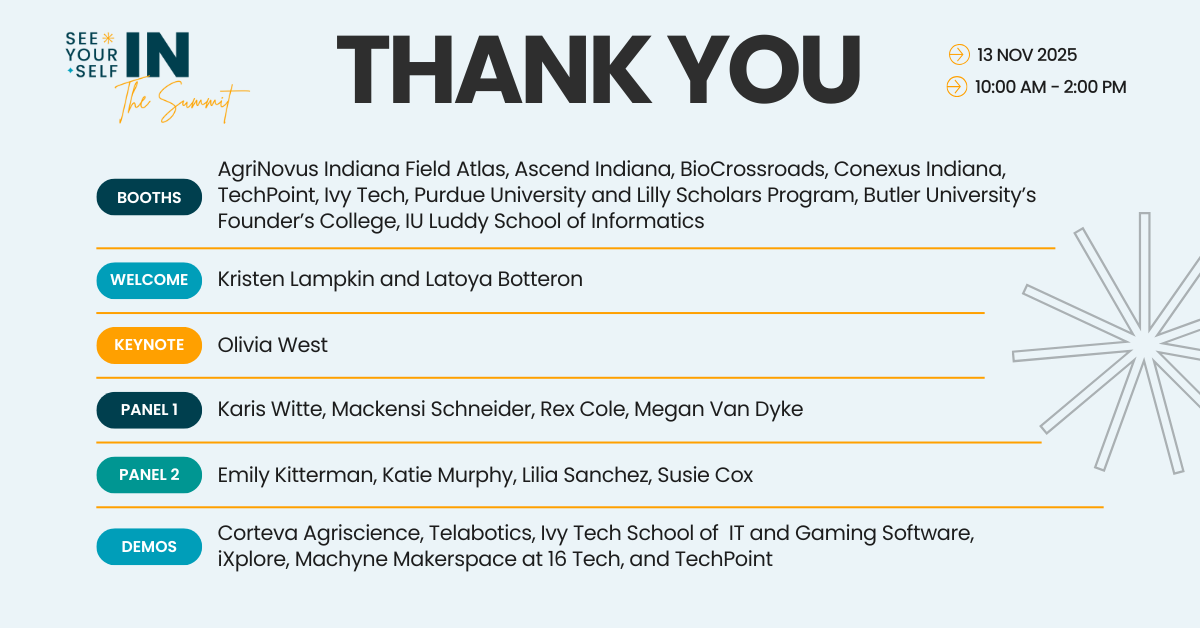
We kicked off the 2025 See Yourself IN Summit with an opening from Kristen Lampkin and Latoya Botteron of CICP, who encouraged students to think boldly about their futures and to go into this day with an open mind of what is out there in Indiana.
We then welcomed Olivia West, in-game host for the Indiana Fever and Indiana Pacers, to the stage, where she shared an inspiring keynote about the importance of values – our GPS system – and how those values lead us toward decisions that affect our future. She inspired all of us to think big and to stay curious, both at the summit and in life.
Across the Summit, speakers from CICP’s branded initiatives and partners — TechPoint, AgriNovus, BioCrossroads, Conexus Indiana, and Ascend Indiana — shared insights into the future of work and the incredible opportunities emerging in technology, life sciences, agbiosciences, advanced manufacturing and logistics, and beyond. They were also able to share opportunities for students to get plugged in and get a jumpstart on their careers, whatever that path may be.
The morning session ended with two valuable panel discussions that exposed students to real stories of success and validation that it’s okay to not know your next step. We first welcomed a group of current students who are tied to CICP’s various talent programs, including Field Atlas, Xtern, and the Modern Apprenticeship Program (MAP). These individuals – Mackensi Schneider, Megan Van Dyke, and Rex Cole – were joined by AgriNovus Indiana Career Success Manager Karis Witte to discuss their respective programs as well as their advice for students who may be interested in following in their footsteps.
We then transitioned to a panel of early-in-career professionals who have been able to make an impact and find success (and their voice) in various advanced industry careers. Susie Cox, an Automation Leader at Corteva Agriscience, Katie Murphy, a Manufacturing Engineer at Arcamed, and Lilia Sanchez, a Postdoctoral Fellow at Indiana Biosciences Research Institute joined moderator Emily Kitterman, Director of Careers in Tech at TechPoint on the stage. These individuals were able to share advice to students about finding their path and ways to find success in the advanced industries, as well as offered some perspective on what the “advanced industries” really mean and why they are so important, not just to our state but to our world.
Beyond the stage, the Summit’s industry activations transformed career exploration into something students could touch, test, and experience. From learning about life sciences through VR to extracting strawberry DNA, coding alongside tech mentors to learning about how to use AI, students had a chance to see these advanced industries come to life in very tangible ways. A special thanks to the following groups who volunteered their time and talent to provide these hands-on demos to our students:
Corteva Agriscience: Strawberry DNA Extraction
EMC2 – Facility and Lab Tour
Ivy Tech School of IT and Gaming: Coding Activity
iXplore: Virtual Reality Experience
Machyne at 16 Tech – Tour of Machyne Makerspace and Welding Demo
Telabotics: Robotics Demonstration and Activity
TechPoint – AI Workshop
Many students were eager to share that this was their favorite part of the day, the moment careers felt tangible, accessible, and exciting.
In addition to these hands-on activities, we had several partners who set up booths at the AMP where students could learn about opportunities to take the next step. Butler University’s Founder’s College, IU Indianapolis, Purdue University, Ivy Tech, and each of our branded initiatives – Ascend Indiana, AgriNovus Indiana, BioCrossroads, Conexus Indiana, and TechPoint were able to share opportunities for our high school students to get plugged in and turn today’s excitement into an actionable step forward.
Student Takeaways and Outcomes
Throughout the day, one message came through clearly: There is a place for every student to see themselves IN Indiana’s innovation economy.
As students got their ice cream and headed home for the day, they left with an idea of their values, a new awareness of growing career paths and opportunities, direct connections to mentors, employers, and continuing education, and insights into the skills needed for today’s (and tomorrow’s) jobs.
Perhaps most importantly, they left with a greater understanding that their strengths, interests, and values can help shape their decision-making and influence their path to a fulfilling career, right here in Indiana.
The learning doesn’t stop when the Summit ends. Students, families, and educators can continue exploring resources, career pathways, and videos throughout the year at SeeYourselfIN.com.
A Community Coming Together for Students
None of this would have been possible without our incredible network of partners:
Panelists and speakers who generously shared their time and stories
Exhibitors and activation partners who brought advanced industries to life through hands-on demonstrations
Educators and school leaders who championed their students and made participation possible
CICP’s five branded initiatives who collaborated to create a seamless, meaningful experience for students across the state
This collective effort is what makes the See Yourself IN Summit so powerful. It represents the very best of Indiana’s commitment to developing its future talent.
When Eric Wildeman was wrapping up his degree in public relations, advertising and applied communication at the University of Southern Indiana, he didn’t know what he wanted to do next. So, he interviewed with a variety of organizations, one of which happened to be a logistics firm. But it wasn’t what the company did that won him over. It was the way the company did it.
“It was more of the atmosphere that intrigued me,” he says. “It was a true sales floor. Everyone’s on the phone talking out loud, thinking out loud. It reminded me of a mini Wall Street.”
That was half-a-dozen years ago. Now a business development representative at Evansville’s PFL Logistics – which takes care of warehousing and transporting goods for companies – Eric says he continues to get a rush from the high-energy, fast-paced logistics environment.
Days go by quickly, he says, as he helps customers meet their needs and solve problems. For example, he recently helped a customer with a refrigerated product after the delivery truck was turned away at its destination. As scheduled, the shipment was picked up on a Thursday and delivered by 9 a.m. on Friday, but the receiving dock wouldn’t allow it to unload. Keeping the product refrigerated while waiting for a later delivery slot would cost the client a lot of money, Eric says, so he went into action. Juggling phone calls, pulling together documentation and aligning everyone’s objectives, he got the truck a delivery slot before things got too heated.
It was an achievement that leaned a lot on attributes Eric says are important to his job: problem-solving, communicating clearly and frankly, and managing your time while responding to multiple clients’ needs. Eric credits his family upbringing with giving him a work ethic that allows him to enjoy such challenges, along with an ability to communicate with people with varying roles – from the accounting office to the warehouse floor.
It helps that he gets to do this work in familiar territory. The Evansville native is happy that he found a job that allows him to settle with his wife in his hometown, where he now helps to coach the football team at his alma mater, Mater Dei High School.
Despite stumbling into logistics, Eric says he couldn’t imagine doing anything else. He loves the energy at PFL and in his industry. “It’s something different every day,” he says. “You never do the same thing all day or every day … it’s definitely what I was looking for.”
The path that brought Alex Goebel to her job as a lean digital data analyst at AstraZeneca was not a straight one, but it sure seems to have been the right one.
Alex (short for Alexandra) laughs as she describes the course that brought her to where she is today. Coming out of Mount Vernon High School, she considered medicine – helping patients appealed to her – but didn’t like science. She loved math but couldn’t imagine what she would do with a math degree. (Teach, maybe?) In college, she briefly leaned toward actuarial sciences, but an internship diverted her toward accounting.
When she got a scholarship from AstraZeneca, a conversation with Lean Digital Director Keith Rawley led to an internship working in the company’s warehouse. At first, this only muddied the water. “I had no idea how I would fit in there,” Alex says. “I thought, ‘What am I doing in the warehouse?’”
As it turns out, she was defining her path – a path that, in a way, had been there all along.
Growing up, Alex had always known the hometown pharmaceutical manufacturing operation as Bristol-Myers Squibb (it was acquired by AstraZeneca in 2014). She also knew it as the place where her dad worked. “Honestly, I’d hear my dad talk about it and I’d think, ‘That’s cool,’ she says with a chuckle. “But it doesn’t have anything to do with me.”
The internship changed that, shattering misperceptions she had about manufacturing and logistics as low-tech and dirty operations. She found a clean, exciting facility where even a math major could contribute.
Still, Alex wasn’t certain AstraZeneca was for her. But as she finished her bachelor’s degree in math and accounting at University of Southern Indiana (USI), she interned at a couple of other places, and soon realized that she liked the people, the culture and the work she found at AstraZeneca. She signed on full-time in 2020 and hasn’t looked back.
That’s not to say she settled into a job and stayed put. In her time with AstraZeneca, Alex has explored new opportunities and received promotions. Encouraged to continue learning, she’s taken advantage of classes and training supported by AstraZeneca and also earned her MBA from USI.
Happy to find such a good job in her hometown, where she enjoys hanging out with familiar friends, boating and spending time with family, Alex likes that being with a pharmaceutical firm takes her back to her early passion (“I’ve still got a way to help patients,” she says), and concedes that it is fun to work where her dad works.
So, she plans to stay with AstraZeneca … but not necessarily on a clearly defined path. “I have a career path that I see myself going down, but it’s changed every couple of years,” she says. “One thing about AstraZeneca is, they just surprise me all the time.”
Mackenzie Mulherin went off to college planning to heal people. It turns out her destiny was to heal the planet.
A sustainability project manager in consumer packaging at Evansville’s Berry Global, Mackenzie spends her days working with teams seeking to increase the sustainability of things like plastic drink cups and lids, food packaging and beauty and personal care tubes. Recently, for example, she was excited to announce that her division had just introduced a Wendy’s drink cup made with 20% recycled material, a product that is a trendsetter in the industry.
Consumer packaging was not where Mackenzie saw her future when she entered the University of Southern Indiana. “I started out in nursing,” she says, “but learned that I love marketing. I really love to do that.”
Mackenzie wasn’t out of college long before she set her sights on a job at Berry Global. Growing up in Evansville, she was aware of the company and its reputation as a good employer, and she had some friends who worked there. So, after getting jobs in marketing for smaller firms in the area, she started connecting with people on LinkedIn and networking with colleagues who knew people at Berry Global. The approach worked. She got hired in 2021.
“I just did some things that stood out,” Mackenzie says. “I was able to build up work experience and relevant skills through my past roles, but my network of professional relationships and ability to follow up helped set me apart.”
Sustainability is a multifaceted career, Mackenzie says, that includes everything from the technical engineering of products to the kind of work she does, which often includes working with Berry customers to help them achieve their sustainability goals and provide products that are meaningful to their consumers.
With Berry Global, there are a lot of those customers of customers, Mackenzie points out, as the company makes such a wide range of products. In fact, it is estimated that the average consumer touches a Berry Global product as many as five times a day. It’s not uncommon, she adds, to see Berry Global employees in the grocery store looking at the bottom of yogurt cups and lotion bottles to check for the Berry Global logo.
Citing her career path as an example, Mackenzie encourages other young people to keep open minds, pursue their goals and take risks. She never imagined she would end up in sustainability when she was in college, and she’s delighted to have a job that allows her to help provide for her family and make a real difference in the world.
“I get to do both,” Mackenzie says. “I get to contribute to my family’s income and positively impact the environment.”
If you don’t know what you want to do when you grow up, that’s okay. Many high school students don’t. Your future career doesn’t have to be decided right now. In fact, now is the perfect time to explore different options and opportunities that are out there. But, did you know the things you already enjoy doing every day can give you clues about careers you might thrive in?
Your hobbies and interests aren’t just activities. They’re signals about your strengths, your personality, and the environments where you might feel confident and excited. If you pay attention to what naturally interests you, you can start to See Yourself IN careers that fit.
Here are three questions to help you explore your interests and visualize how those connect to real-world opportunities across Indiana’s advanced industries.
1. What do I enjoy doing when no one is telling me what to do?
When you have free time, what do you choose to do? Those interests offer insight into what kinds of work might keep you motivated long-term.
If you enjoy…
Playing video games → You might like solving problems in digital spaces. That can translate to roles in cybersecurity, software testing, or even working with robotics and automation in advanced manufacturing.
Being outdoors or caring about nature → You might care about sustainability or environmental health. That connects to agbioscience careers like plant science, soil health, or sustainability tech — and even public or environmental health in the life sciences.
Enjoying animals or caring for pets → You may be drawn to animal health, a piece within the agbiosciences and life sciences. Think animal nutrition, veterinary diagnostics, or animal health product testing.
Helping people → You may be motivated by improving lives. That fits careers in life sciences, medical technology, diagnostics, or agbioscience roles focused on nutrition and food safety. (P.S. life sciences, doesn’t just mean “doctor”!)
Tinkering, building things, or taking things apart to see how they work → You may love understanding how things fit together. That curiosity translates directly into advanced manufacturing and logistics — from working with high-tech machinery and robotics to creating the parts and products that power everything from medical devices to electric vehicles.
Your free-time choices don’t define your career, but they do show where your natural interests live.
2. What kinds of problems do you like to solve?
Every job is basically a different type of problem-solving. Understanding the type you enjoy can point you toward fields where you’ll feel energized instead of drained.
If you like…
Figuring out how things work or fixing things → hands-on, technical roles may be a great fit (advanced manufacturing, robotics technician, engineering support).
Finding patterns or thinking logically → you might enjoy data-oriented roles (analytics, operations, or quality testing across industries).
Making things easier, faster, or more efficient → you might be drawn to logistics or process improvement careers.
Experimenting, testing, or being curious about science → lab roles, biotech support, or materials testing could match your strengths.
How you solve problems can be just as important as a specific major or job title.
3. What skills do I naturally use without thinking about it?
These are the strengths everyone else sees in you, the things you do well without trying. They are huge career clues.
If you naturally…
Notice details → You could be great in roles that require accuracy, like quality control in advanced manufacturing, lab testing in the life sciences, or data monitoring in agbioscience and logistics.
Stay calm under pressure or handle fast-moving situations → You might thrive in healthcare support within the life sciences, operations roles in logistics, or troubleshooting and monitoring roles in technology.
Pick up new tools or technology easily → This strength is valuable in robotics and automation roles in advanced manufacturing, software testing or IT support in tech, and lab or field equipment use in agbiosciences and life sciences.
Work well with others or communicate clearly → You may stand out on manufacturing and logistics teams, in lab or research environments in life sciences and agbiosciences, or in collaborative technology projects.
Think logically or enjoy step-by-step problem-solving → You might enjoy careers in process improvement or operations within logistics, data-focused roles in technology or research, or engineering support in advanced manufacturing.
Learn best by doing or enjoy hands-on work → You could thrive as a technician in manufacturing, robotics, or biotech, in equipment operation roles across supply chain settings, or in lab and field testing positions in agbiosciences and life sciences.
Strengths aren’t always academic. Sometimes career clues come from your personality, so pay attention to what you are good at and what other people are affirming you for.
Ready to start exploring?
Your hobbies won’t tell you exactly what to become, but they will help you understand yourself better. And when you know yourself, it’s easier to see where you might fit in Indiana’s growing opportunities, whether it’s life sciences, agbiosciences, tech, advanced manufacturing and logistics, or beyond.
From Carmel High School to Purdue University to Allison Transmission, Vincent Mai’s journey shows how curiosity and initiative can lead to a thriving career in Indiana’s advanced industries.
Vincent, what first got you interested in engineering?
In high school, I wasn’t completely sure what I wanted to do. However, robotics was the turning point—it gave me the confidence to pursue a career in engineering.
What classes helped shape your career path?
Definitely the Project Lead the Way courses. Those intro engineering classes, digital electronics, and engineering principles showed me the basics. They provided me with a solid foundation for pursuing a STEM career in Indiana.
How did you land your first role with Allison Transmission?
Funny enough, Allison was a sponsor of my high school robotics team. Later, at Purdue’s Industrial Roundtable, I reconnected with them. That led to two internships—one in 2017 and one in 2018. After that second internship, I knew I wanted to be there full-time.
What do you do today as a Control Systems Engineer?
The easiest way to describe it is a software engineer with extra responsibilities. Some days I’m coding and designing; other days I’m out on test trucks or public roads testing the systems we’ve built. It’s a great mix of analysis, software development, and hands-on application.
What skills have been most valuable in your career?
Communication is huge. When I’m working with peers, they want technical detail. But leaders often just want the big picture. Knowing how to adapt your communication style is essential in advanced industries.
What lessons would you share with students or young professionals exploring STEM careers in Indiana?
I’d share three things:
Be open-minded. Don’t lock yourself into one idea too early.
Be flexible. Life will throw curveballs—be willing to adjust.
Take initiative. Speak up about your interests so people can help you grow.
Looking back, what stands out most about your journey?
That you don’t need to have it all figured out. I thought I’d go into aerospace or maybe medical technology. Instead, I found a career in advanced manufacturing and automotive right here in Indiana—and I love it.
If you love problem-solving, design, and teamwork, manufacturing and advanced industries in Indiana might be the perfect fit for you. Explore opportunities and discover your path through See Yourself IN!
When Vincent Mai joined his high school robotics team in Carmel, Indiana, he didn’t know it would set him on the path to a career in one of Indiana’s most important advanced industries—automotive manufacturing.
“I wasn’t 100% sure what I wanted to do in high school,” Vincent recalls. “I knew I liked engineering and technical work, but robotics gave me the confidence to pursue it as a career.”
That passion carried him to Purdue University, where he earned a degree in mechanical engineering—a field he describes as the “jack of all trades” that opens doors to careers across industries.
A Career That Started in High School
Vincent’s favorite classes were the Project Lead the Way courses, where he learned the principles of digital electronics and engineering basics. “Those classes showed me what STEM careers in Indiana could look like,” he says.
Through robotics, he also met professionals from Allison Transmission, an Indianapolis-based leader in advanced manufacturing and automotive technology. That early connection turned into two internships during college—hands-on experiences that shaped his career.
“I interned at Allison in 2017 and 2018. By the end of that second summer, I knew it was where I wanted to be full-time,” Vincent says.
From Internships to Engineering
Today, Vincent works as a Control Systems Engineer at Allison Transmission, developing and testing software that powers vehicles worldwide.
“My role is like being a software engineer with extra responsibilities,” he explains. “Some weeks I’m coding and designing at my desk. Other weeks, I’m on the test track, putting that software into trucks and evaluating performance.”
For Vincent, this combination of design, implementation, and real-world testing makes his career dynamic—and deeply rewarding.
Lessons for the Next Generation
Vincent has three lessons for anyone exploring how to start a career in engineering or Indiana’s advanced industries:
Be open-minded. “Try new things—you never know what opportunities will open up.”
Stay flexible. “Plans change, and that’s okay. Sometimes you discover you like a different path.”
Take initiative. “If there’s something you’re passionate about, tell your managers and mentors. That’s how you create your own opportunities.”
Building a Future in Indiana
Although Vincent once considered aerospace or medical engineering, advanced manufacturing and automotive jobs in Indiana proved to be the right fit.
“Indiana has so many opportunities in advanced industries,” he says. “I started with robotics in high school, built skills at Purdue, and now I’m working on real-world solutions right here at home. You can absolutely build a career you love—right here in Indiana.”
Want to turn your interests into a meaningful, fulfilling career? Explore opportunities in Indiana’s growing industries and discover the connections, programs, and possibilities that can help you See Yourself IN Indiana’s advanced industries. Get started today!
When you’re in high school, it can feel like everyone is asking the same big question: “What’s next?” But the truth is—you don’t need to have all the answers yet. What you do need is a chance to see what’s out there, to start imagining what’s possible, and to begin connecting your interests to future opportunities.
That’s exactly what the See Yourself IN High School Summit is all about. On November 13, 2025, students from across Indiana will come together for a one-day event designed to spark curiosity and open doors. You’ll get a chance to hear from people who were recently in your shoes, explore industries you may not have thought about before, and begin to picture where your future might take you.
Here are seven reasons you’ll want to be part of it:
1. Discover careers you didn’t know existed
There are so many career options beyond the ones you usually hear about. At the Summit, you’ll get to see some of Indiana’s fastest-growing industries in action:
Agbiosciences: From food and farming to sustainability and innovation.
Life Sciences: From creating new medicines to improving everyday health.
Technology: From apps and software to cybersecurity and data.
Advanced Manufacturing & Logistics: From robotics and aviation to moving goods across the globe.
Each of these fields is full of opportunities for people with all kinds of strengths – whether you like problem-solving, being creative, working with your hands, or exploring new ideas.
2. Hear from people who were once in your shoes
In the morning, the Summit will feature panels with current students and young professionals in Indiana who are now building careers in these industries. They’ll share their journeys—what they liked in high school, how they explored their interests, and what led them to where they are today.
You’ll get to hear real stories, not just polished success highlights, and ask questions that could help lead you to your next step. These conversations will show that career paths are rarely straight lines, and that exploring your options in high school is a valuable first step.
3. Get a taste of different industries
In addition to panel discussions, you’ll also have the opportunity to learn through hands-on demos and activities that give you a simple, hands-on way to learn what these industries are all about. Think of it as “test driving” different fields—you’ll get just enough to spark curiosity without needing to know all the details. Each experience is designed to give you a small glimpse into what careers in that field could look like.
4. See Indiana in a new light
It’s easy to think that the most exciting careers are in big cities far away. But the truth is, Indiana is full of innovation and opportunity. Right here at home, people are working on things that impact not just our state, but the entire world.
The Summit will help you realize that whether your interests lean toward science or tech, computers to hands-on work, there’s a place for you in Indiana’s future. You don’t have to go far to make a big impact—you can start right here.
5. Explore different paths after high school
There isn’t just one path forward after graduation, and the Summit helps you explore the different options that are out there. Some careers do require a four-year degree, but many others start with apprenticeships, certifications, or even direct-to-work opportunities where you continue learning on the job.
The industries represented at the Summit value all kinds of training and education. That means no matter what path you choose, there are ways to connect your strengths to a career. High school is the perfect time to explore those options and think about what fits you best.
6. Get inspired by real stories
Throughout the day, you’ll hear inspiring stories from people who turned their everyday interests into careers. Maybe they grew up with a love for helping others and now work in agbiosciences, helping to feed our planet. Maybe they loved tinkering with computers and now work in tech. Maybe they liked their science classes and found their way into life sciences – in a career that didn’t require med school. Or maybe they enjoyed learning how things are made and moved around the world and now thrive in a career in logistics.
These stories prove that your unique passions and skills can lead to real opportunities—and that Indiana has a place for your talents.
7. It’s all about YOU!
The See Yourself IN High School Summit is designed with high school students in mind. You don’t need to know your career goals or even have a plan yet. The goal of the day is simple: to give you exposure, spark your curiosity, and help you start asking new questions about your future.
You’ll leave with more ideas than you came with, and hopefully with a clearer picture of the many directions your next step could take.
Ready to See Yourself IN?
The See Yourself IN High School Summit isn’t a career fair – it’s a day of meaningful exploration. It’s about discovering new possibilities, meeting people who have walked the path before you, and seeing how your own interests could connect to Indiana’s future.
So, whether you’re curious about a specific industry or are simply figuring out what comes next, the Summit is for you. Join us on November 13, 2025, and take the first step toward seeing yourself in a whole new way.
This summer, six interns gained hand-on-experience across three of CICP’s initiatives; Ascend Indiana, TechPoint, and CICP itself. These opportunities offered enriching “foot in the door” opportunities for young professionals eager to explore Indiana’s advanced industries.
Among them was Kendall Troy, a second-year student at Indiana University Indianapolis, who participated in TechPoint’s Externship Program. Anastasia Cook, a soon-to-be junior at Rose-Hulman Institute of Technology, Jackson Stone, an incoming senior at Purdue University, Dev Patel, who is pursuing his Master of Science in computer science at Indiana University and Ahmet Arslan, an incoming junior at Purdue University, interned across various departments and teams with Ascend Indiana, while Lucy Furqueron, a rising junior at Texas Christian University joined the CICP communications team as an intern.
Hands-on Experience:
Lucy Furqueron, CICP
Across all departments, interns were empowered to explore, create, and contribute in significant ways to their teams. These internships are designed to help young, aspiring professionals develop useful, real-world experience, aiming to build a foundation of success and begin shaping their professional lives. Many interns reflected on how applying classroom knowledge to their position brought clarity and greater direction to potential career goals.
“I have really enjoyed immersing myself within a communications department” said Lucy Furqueron (CICP). “You learn so much from being on the ground able to see and experience the realities of what the job looks like and what you might be doing in your own career eventually.”
Ahmet Arslan, Ascend Indiana
Ahmet Arslan (Ascend Indiana), said “There was a strong sense of shared ownership, and the focus was entirely on finding solutions together. It was during this time that I truly saw Ascend’s supportive and inclusive culture in action.”
Engage with Networking Opportunities:
Kendall Troy, TechPoint
Internships also provide students with valuable networking opportunities. Events offered throughout internship programs become an opportunity to help create connections and learn more about the industry.
“A highlight of my internship has been going to all of the events TechPoint has put on and being able to take events photos for them.” said Kendall Troy (TechPoint). “TechPoint has many community events that involve networking within the Indianapolis tech community. Through these events, I’ve been given the opportunity to meet many founders, CEO’s, and employees in the Indiana tech sector and I feel as if I’ve been able to grow my community and tech network in the Indianapolis area.”
Jackson Stone, Ascend Indiana
Jackson Stone (Ascend Indiana) said “Being in product and project management requires a lot of communication between multiple verticals, which excited me because I get to meet a lot of different people and work with them to improve our ideas.”
Growing your Skillset:
Anastasia Cook, Ascend Indiana
A notable aspect of an internship with CICP and its initiatives is the ability for interns to take on their own projects and work. Interns are entrusted with tasks and projects that encourage ownership and deeper learning, skills that are essential for any industry
Anastatia Cook (Ascend Indiana) said “I’m so glad I had the opportunity to work on a wide range of projects, acting as a “Jack of all Trades”. I was involved in everything from research and competitor analysis to writing user stories and conducting QA testing.”
Dev Patel, Ascend Indiana
“A lesson I’ve learned during my internship is the power of taking ownership early and approaching challenges with a problem-solving mindset.” Said Dev Patel (Ascend Indiana). “Success in fast-paced, technical environments doesn’t come from having all the answers, it comes from being curious, collaborative, and willing to own and solve hard problems.”
These stories and CICP’s continued commitment to providing internship experiences and programs is a testament to their investment in not only the individual, but the next generation of Indiana’s workforce. Through real-world experiences and professional and personal growth these students are taking steps towards meaningful, motivated careers.
If you want more information on Indiana’s advanced industries, as well as how you can get involved with Indiana’s next generation of leaders, be sure to click the link below.
Whether you’re early in your high school journey or are heading towards whatever is next, now is a critical time of exploration and change.
When you think about your future career, do you want to do something that matters? Would you like to help people? Protect the planet? Solve problems that actually impact the world around you?
If this sounds like you, those careers are out there. And, the good news is, they’re right here in Indiana. Whether you’re into science, technology, hands-on work, or creative problem solving, there is a path out there to for you.
Here are 8 careers where you can do meaningful work, right here in Indiana.
8 Careers that Make a Difference
1. Precision Agriculture Technician
Precision Agriculture Technicians use advanced tools like drones, GPS, and data software to help farmers grow more food using fewer resources. As the world’s population continues to grow, it’s becoming increasingly important to meet the increased demand for food. Agricultural technicians use technology to be more precise and efficient when it comes to creating better food (and more of it). On the job, they might install or operate high-tech farm equipment or even fly drones to collect insights on fields. At the end of the day, they help farmers make data-driven decisions that increase supply and reduce waste. This ensures that our communities have the food they need both now and in the future.
Bioinformatics specialists use computer science and biology to analyze data, especially genetic data, to understand diseases and develop treatments. By having a better understanding, scientists and doctors can develop new treatments and personalize medicine for patients, contributing to a healthier world. Bioinformatics specialists often find themselves developing and managing databases of genetic information and collaborating with biologists, geneticists, and researchers to turn insights into action. Whether engaged in cancer research, tracking infectious disease, or personalizing medicine, this career path makes an impact on peoples’ lives and well-being.
Cybersecurity specialists are responsible for planning, implementing, and monitoring hardware and/or software security measures that protect computer systems, networks, and sensitive data from cyberattacks. Think of this role as a digital bodyguard, protecting all kinds of businesses, like schools, hospitals, even government agencies, from hackers, viruses, and online threats. Day to day, cybersecurity specialists might find themselves setting up firewalls and security protocols or investigating breaches or attempted hacks. Additionally, they are responsible for educating employees on safe online practices. With almost everything we do today, from baking to healthcare to school records, relying on digital systems, cybersecurity specialists play an important role in protecting our data and information.
Mechatronics technicians work at the intersection of mechanical systems, electronics, and computer technology to keep advanced manufacturing machines running efficiently. These high-tech systems are used to produce everything from electric vehicles to medical devices. On the job, mechatronics technicians may install or repair robotic arms, troubleshoot mechanical or software issues, or program automated systems that help make factories safer, faster, and more efficient. By keeping the technology behind production lines running smoothly, mechatronics technicians play a crucial role in delivering the tools, products, and innovations our world relies on.
5. User Experience (UX) Designer
UX (User Experience) designers make technology more human by designing apps, websites, and digital tools that are easy to use and enjoyable to navigate. Their work is especially important in areas like healthcare and education, where accessible and intuitive design can make a big difference in people’s lives. UX designers often work with users to understand their needs, sketch layouts and wireframes for a new app, and collaborate with software developers to bring the ideas to life. This role combines creativity with problem-solving (and technical skills), so if you enjoy blending design with real-world impact, UX design could be a rewarding career path for you!
Public health program managers lead initiatives that improve the health and well-being of people at the community level. For example, they might organize vaccine clinics or mental health awareness campaigns, turning big ideas into real-world programs that help people live healthier lives. This role may find themselves managing budgets, coordinating with healthcare providers, overseeing outreach efforts, and even analyzing data. This role is a great way to blend an interest in science with project management, communication, and problem-solving skills, making it a great option for people who are interested in health and well-being at a community level, without an interest in becoming a doctor.
7. Supply Chain Analyst
Supply chain analysts help make sure essential goods (like food, medicine, and emergency supplies) get where they need to go, when they’re needed most. They work behind the sciences to analyze data, forecast demand, and solve logistical challenges so products move efficiently from manufacturers to customers. On the job, a supply chain analyst might study trends to prevent shortages, improve delivery rounds, or help a company efficiently respond to disruptions like natural disasters or weather events. This work also has a direct impact on everything from stocking grocery store shelves to ensuring hospitals have the equipment they need. If you’re interested in solving problems and are interested in making a difference in how the world works, a career in supply chain may be an option to explore.
8. Plant Geneticist
Plant geneticists work at the intersection of science and sustainability, developing crops that are more nutritious, resistant to disease, and able to thrive in changing climates. Their work plays a key role in solving global challenges like food insecurity, hunger, and agricultural sustainability, which is especially important as the world’s population grows. On the job, they might analyze plant DNA in a lab, breed new crop varieties in a greenhouse, or work with farmers in the field to test how new plants perform in real-world conditions. Thanks to their research and innovation, we now have drought-resistant grains, vitamin-enriched produce, and crops that require fewer pesticides. If you’re interested in biology and want to use science to make a real difference in the world, plant genetics could be your path.
Impactful careers are all around you. Whether you’re drawn to science, technology, design, or hands-on work, there’s a meaningful path waiting for you right here in Indiana. These roles extend beyond just a paycheck. They offer purpose.
As you think about your future, explore what matters to you, and where your interests lie. Are you passionate about protecting the planet? Helping people stay healthy? Building smarter solutions that are easier to use? The jobs highlighted here are just the beginning, and there are so many careers available that can help you make a difference.
So, ask yourself: what kind of impact do you want to make? Then, start exploring. Because Indiana’s advanced industries need problem-solvers like you.