When people think about the Month of May in Indiana, they usually think about fast cars, race day traditions and the excitement of the Indy 500.
But behind every lap is an entire team of people working across Indiana’s advanced industries to develop and test the technology, make and move things around the country (and the world), analyze data and make decisions that bring race day to life.
Modern racing depends on advanced industries — and many of the careers that help power race day are the same careers helping shape Indiana’s future every day.
Whether you’re interested in hands-on work, problem-solving, creativity or technology, there are many ways to be part of industries like these right here in Indiana.
Engineering
From designing vehicle systems to improving performance and safety, engineers help turn ideas into reality. Engineers across disciplines use creativity, problem-solving, and technology to design, test, and improve systems people rely on not just on race day, but every day.
Some careers in this field include:
Mechanical Engineer
Industrial Engineer
Electrical Engineer
Systems Engineer
Engineers often work with advanced technology, testing systems, solving problems, and helping improve performance and safety in fast-paced environments.
Advanced Manufacturing
Careers in advanced manufacturing combine hands-on work with advanced technologies and precisions tools that help drive innovation across Indiana’s economy. Advanced manufacturing professionals help build the parts, materials and systems used across industries including transportation, life sciences, aerospace and motorsports.
Some careers in this field include:
CNC Machinist
Automation Technician
Quality Engineer
Robotics Technician
Indiana is a national leader in advanced manufacturing and logistics, with companies across the state helping design, produce and move products around the world.
Technology + Data
Technology plays a major role as its own sector as well as across Indiana’s advanced industries, from software development and cybersecurity to data analytics and artificial intelligence. In the context of racing, teams rely on software, analytics and real-time data to make decisions quickly and improve performance.
Some careers in this field include:
Software Developer
Data Analyst
Cybersecurity Specialist
Data Scientist
TechPoint’s Careers in Tech platform helps you uncover some of the top career paths and opportunities across Indiana’s technology sector. Visit techpoint.org/careersintech to learn more!
Logistics
Getting materials, tools and equipment where they need to go takes planning, coordination and teamwork. Logistics and operations professionals help coordinate the movement of products, materials, and equipment across complex systems and supply chains.
Some careers in this field include:
Supply Chain Specialist
Logistics Coordinator
Operations Manager
Transportation Analyst
Indiana’s advanced manufacturing and logistics industries play a major role in moving products and materials across the country and around the world.
Media + Communications
Race day also depends on creative professionals who help tell stories and connect with fans. Photographers, videographers, marketers and communications teams help bring events to life both in person and online.
Some careers in this field include:
Videographer
Graphic Designer
Social Media Manager
Communications Specialist
These careers combine creativity, storytelling and technology — and opportunities exist across Indiana’s advanced industries.
Finding Your Path
There’s no single path into advanced industries careers. Explore more opportunities at SeeYourselfIN.com.
Whether your interests are in technology, engineering, manufacturing, logistics or creative work, Indiana’s advanced industries offer opportunities to explore careers that help power innovation every day — on and off the track.
We’ve all heard those stories about engineers who started out as little junior engineers. When they were kids, they were always building things with Legos or tinkering with machines.
Braxton Bragg says that wasn’t him.
The future Product Innovation Engineer with Evansville’s Berry Global was more into sports.
As he got older, though, the foundation for a career in engineering took shape. At New Albany High School, along with participating in athletics, Braxton found that chemistry, physics and math interested him, and that he wasn’t half bad at those subjects. His junior and senior years, he took a job working on a farm and discovered that the mechanics of the tractors and other equipment fascinated him. As these factors pulled together, he recognized where his path was leading. When he headed off to college at the University of Southern Indiana, he majored in engineering.
And when an opportunity for an internship at Berry Global came up during his sophomore year, Braxton jumped on it. He was familiar with the plastic container and product company, but didn’t know much about its operations. What he learned hooked him in a hurry.
“I was blown away by how much goes into making a plastic drinking cup or plastic lid or the container that holds your products in the grocery,” Braxton says. “The kind of technical crew it takes to pull off efficient production of something like that, it took me for a shock.”
Hired on as a full-time employee in 2019 and promoted to his current position in 2020, Braxton says he enjoys being a part of the company’s global headquarters because that gives him a front-row seat to everything from product ideation to seeing items he worked on come off the production line. He currently has five or six projects on which he serves as project manager, he says, all in different stages. He enjoys the variety of the work and the fact that every day can be a little different.
He also enjoys the constant drive to make better products more efficiently. “Coming up with a better way to make a better widget that nobody else can make, that’s always the process,” Braxton says. “Innovation as a whole is consistent on the product and process side.”
And he’s delighted to have landed a job with all those features just a short drive from his hometown. Married to his high school sweetheart, Braxton enjoys staying in touch with friends and family and taking advantage of Southern Indiana’s hunting and fishing options. And while engineering ultimately took up a larger part of his life than the sports that he focused on as a kid, he hasn’t given up athletics completely. He’s taken up running, and he’s preparing to run his second marathon.
You could call Carter Burnett’s career a turn-key operation.
When he turns the key in the ignition of the truck he drives, Carter is on the job, piloting a $250,000 piece of equipment carrying a payload likely worth a lot more and tracking an endless parade of variables to make sure he gets products where they need to be, when they need to be there.
It can be tiring and stressful, but Carter enjoys the independence that comes from not having a boss looking over his shoulder. Best of all, when he turns the key to shut off the engine, he leaves the job behind … unlike people who constantly worry about workplace responsibilities.
“Once I step down from the cab, I’m no longer at work,” he says.
Carter hadn’t always planned this career. When he left high school in Owensboro, Ken., he headed off to college because that’s what people said you needed to do to be successful. But that didn’t go the way he planned. After a while, he was back home working construction.
Then he got an unexpected opportunity: He could learn to drive trucks like his dad and grandad, for the company that employs his dad. Although he had never imagined following in his father’s footsteps, Carter was encouraged by the fact that his dad had made a rewarding quarter-century career out of driving a truck. And the company, Evansville’s JR’s Expedited Freight, was offering to pay for the training Carter needed to get a Commercial Driver’s License. In exchange, Carter signed a two-year contract.
That was about 18 months ago, so now you’ll find Carter on the road a few days each week, driving hundreds of miles at a time, usually between Henderson, Ky., and Virginia Beach, Va. It’s a job that requires sharp time-management skills and trustworthiness – after all, you’re in charge of hundreds of thousands of dollars of equipment and cargo – and you have to balance the time away from home with the freedom you get when you are home.
As unexpected as a career in the trucking industry was for Carter, he plans to stay, albeit not always on the road. He hopes someday he’ll find a role to play that keeps him closer to home, where he can be with family and spend more time tinkering with cars.
Regardless, though, he is confident he’ll consider himself a success, despite what he thought when he left high school.
“Success isn’t defined by what degrees you have and what colleges you went to,” Carter says. “Success is, ‘Am I doing something I enjoy?’ Because if I go home every day and hate what I’m doing, I’m not going to think I’m successful.”
Julia Hatfield didn’t always know she’d become an engineer designing custom implants that change lives. What she did know was that she loved problem-solving, math, and science—and that curiosity led her to a career in one of Indiana’s fastest-growing advanced industries.
In this conversation, Julia shares how she found her path, why Indiana is the ideal place to build a future, and offers advice for Gen Z students starting to think about their own careers.
Julia, take us back. How did your interest in life sciences and engineering begin?
In high school, I took an anatomy class and discovered how much I loved learning about the human body. At the same time, I already knew I enjoyed math and science, and I’ve always loved problem-solving. Putting all of that together, biomedical engineering felt like the right direction; it allowed me to innovate in ways that could truly help people.
What made you choose the University of Toledo for college?
Their bioengineering program required three co-ops. That was huge for me because it gave me the chance to get into the field, not just sit in a classroom. I wanted to see how engineering worked in real life, and those internships had a significant impact on my career.
How did you first connect with Zimmer Biomet?
I actually met them at a career fair in Toledo. I ended up doing two internships with them here in Indiana—one focused on shoulder implants, and the other on research using advanced microscopes to study how materials fail. Those experiences showed me how broad and exciting this work could be.
Tell us about your current role.
I’m a development engineer on the Patient-Matched Implants team at Zimmer Biomet. That means I design implants that are custom-made for individual patients, usually for shoulders. A patient undergoes a CT scan, and we turn it into a 3D model. Then, I design an implant that fits their exact needs. It’s highly specialized, and every case is unique.
Currently, I’m working on approximately 60 different cases simultaneously, making for a fast-paced environment. However, it’s incredible to know that something I design could alleviate someone’s pain and restore their mobility.
What excites you about your work?
For me, it’s seeing the direct impact on patients. I’ve been able to attend surgeries and watch implants I designed being used. It’s surreal. And it’s not just local — some of the implants I’ve worked on have gone to patients as far away as Japan. Knowing my work reaches people all over the world is really motivating.
Looking back, did you always know you’d be on this path?
Not at all. In high school, I didn’t have a detailed plan. I just followed my interests, took advantage of opportunities like internships, and let things fall into place. That’s something I’d want Gen Z students to know: you don’t have to have it all figured out. What matters is trying things, learning what excites you, and being open to change.
What advice would you give to students exploring Indiana’s advanced industries?
Surround yourself with goal-oriented people—they’ll motivate you. Don’t be afraid of mistakes. They’re inevitable, but they help you grow. Finally, get hands-on experience through internships, co-ops, or shadowing. Even if you don’t love it, you’ll learn what direction you do want to take.
Why Indiana? What keeps you here?
Indiana is the hub for advanced industries — especially life sciences. Warsaw is the orthopedic capital of the world. For someone like me who wants to innovate, collaborate with surgeons, and make a real impact, this is the place to be.
Julia Hatfield’s story shows that pathways into Indiana’s advanced industries don’t require a perfect plan—just curiosity, persistence, and a willingness to try. Her story is also an important reminder that you can build a career that matters right here in Indiana.Explore opportunities and discover your path through See Yourself IN!
Ashley Jeffirs didn’t start college knowing exactly where she wanted to end up. But through curiosity, adaptability, and hands-on experience, she found her passion in Indiana’s advanced industries. Today, she’s a manufacturing engineer at Zimmer Biomet, working in a foundry where molten metal becomes life-saving implants.
Here’s her story in her own words.
Ashley, did you always know you wanted to be an engineer?
Not at all. In high school, I knew I loved math and science, but I wasn’t sure how that would translate into a career. I initially tried biomedical engineering, but I quickly realized the medical side wasn’t for me. That’s when I shifted to mechanical engineering—and that’s where everything clicked.
How did you connect with Zimmer Biomet?
I first learned about them through a career fair at Trine University. I ended up landing an internship in extremities manufacturing. That experience provided me with hands-on exposure to what engineering looks like in the real world, and it really helped me figure out what I wanted to do after graduation.
What do you do today?
I’m a manufacturing engineer in Zimmer Biomet’s foundry. Essentially, we create wax patterns, build ceramic molds, and then pour molten metal at approximately 3,000 degrees to produce implants. Instead of producing one part at a time, we can make 20 in a single pour. It’s fast, intense, and really rewarding to see the process from start to finish.
What is the coolest part of your job?
Honestly, I never thought I’d fall in love with the foundry. But the first time I worked with metal, I knew this was where I belonged. Now, I get to transform raw materials into implants that restore mobility and improve lives. That’s an incredible feeling.
You’ve already made some impressive contributions. Can you share one?
One of the biggest was redesigning a tool so it lasted a full year instead of just three weeks. That was huge for efficiency. I also led a scrap reduction project that saved the company about $383,000. But honestly, what excites me most isn’t just the numbers, it’s collaborating with operators on the floor.
You were recently named to the Conexus Indiana Rising 30 class. What does that recognition mean to you?
It was an incredible honor. To me, it’s not just about the award, it’s about showing what’s possible when you pursue opportunities in Indiana’s advanced industries. Being recognized alongside so many talented young professionals reminds me that young people, especially young women, have the power to shape the future of these industries. It motivates me to keep pushing, innovating, and supporting the next generation that will come after me.
You shared that you’re incredibly passionate about mentorship, specifically supporting other women and interns at Zimmer Biomet. Why is this so important to you?
Mentorship is huge. I wouldn’t be where I am today without the people who guided me, challenged me, and helped me see what I was capable of. That’s why I’m passionate about paying it forward. Advanced industries can feel intimidating, especially for women, but I want to be the kind of mentor who says, “You belong here, and your voice matters.” For me, it’s about opening doors, building confidence, and making sure the next generation of women feels supported and empowered to lead.
What advice would you give to others who are trying to figure out their futures?
Don’t stress if you don’t have it all figured out right now. I didn’t either. Be adaptable, because your path will change, and sometimes those detours lead to the best opportunities. Find balance and make space for yourself outside of school or work, because you can’t pour from an empty cup. And don’t be afraid to use your voice. Even if you’re the youngest in the room, your perspective is valuable and can spark real change.
What makes Indiana the right place to launch and grow your career?
You don’t have to leave Indiana to do meaningful work. There are opportunities here to innovate, solve real-world problems, and build careers that positively impact lives. That’s what keeps me here—and why I’m excited about the future.
Ashley Jeffirs’ journey shows Gen Z that you don’t have to have everything figured out right away. Sometimes, the right pathway reveals itself when you’re willing to try, adapt, and discover where you truly belong—and Indiana’s advanced industries are the perfect place to start. Explore opportunities and discover your path through See Yourself IN!
When Julia Hatfield signed up for high school anatomy, she thought it would just be another science class. Instead, it sparked a journey that led her to a career designing life-saving implants at one of Indiana’s most innovative companies.
Today, Julia works as a development engineer at Zimmer Biomet in Warsaw, Indiana—known worldwide as the orthopedic capital of the world. Her job? Designing patient-matched implants that restore mobility and reduce pain for people facing cancer, fractures, and other conditions that standard implants can’t fix.
“For me, it’s never just about the engineering. It’s about giving someone the ability to hug their kids, return to work, or simply live without pain. That’s what makes this career so meaningful,” Julia says.
Her path wasn’t straight or obvious — and that’s exactly why her story matters to Gen Z students who may be wondering how to find their own careers in Indiana’s advanced industries.
Discovering a Passion for Innovation
Julia grew up in Newport, Michigan, in a family where no one worked in the engineering field. Her dad was a firefighter, her mom a teacher, and most relatives worked blue-collar jobs. Still, she was drawn to math, science, and problem-solving.
When she chose to study bioengineering at the University of Toledo, it wasn’t just the classes that excited her; it was the required co-ops. Those internships provided her with real-world experience in designing implants and conducting research, demonstrating that engineering isn’t just about equations—it’s about making an impact.
“Internships completely shifted my perspective,” Julia says. “They helped me discover my passion, test out real-world problem-solving, and see firsthand how advanced industries shape people’s lives.”
From College to Career in Indiana’s Advanced Industries
After two internships with Zimmer Biomet, Julia knew Indiana was where she wanted to launch her career. Now, as part of the Patient-Matched Implants team, she collaborates directly with surgeons to design custom solutions for patients worldwide.
Unlike traditional engineers who may spend years on a single product, Julia’s work is fast-paced and highly personalized. She currently manages more than 60 active cases simultaneously—each requiring critical thinking, creativity, and effective communication.
“No two projects are ever the same,” Julia says. “From CT scans to 3D models to custom implants, every case pushes me to think differently. The moment I see one of those implants used in surgery, it’s this powerful reminder that my work is changing lives.”
Advice for Others: Creating your Own Pathway
Julia knows many high school students don’t have it all figured out, and that’s okay. She didn’t either. What mattered most was surrounding herself with the right people, staying curious, and being willing to try new things.
Her advice for others considering a future in Indiana’s advanced industries:
Find your circle. Surround yourself with goal-driven individuals who challenge and inspire you to grow.
Embrace mistakes. Every error is a lesson that makes you stronger.
Get hands-on. Internships, shadowing, or even short-term experiences can help you discover what excites you — and what doesn’t.
Why Indiana is the Place to Build Your Future
Indiana is a national leader in advanced industries, including life sciences, agbiosciences, advanced manufacturing, logistics, and technology. These fields are growing, global, and in need of innovators ready to bring new ideas and perspectives.
“Life sciences isn’t just for doctors,” Julia says. “If you love creating, innovating, and solving problems, there’s a place for you. Indiana offers incredible opportunities to turn those skills into a meaningful career.”
For those still shaping their path, Julia’s story shows that curiosity is often the spark—and with persistence, it can ignite a career that transforms lives. Start exploring Indiana’s pathways today!
When Ashley Jeffirs walked onto her college campus, she wasn’t sure what career path she wanted to follow. She knew she loved math and science, but she also knew that biomedical engineering wasn’t the right fit for her.
Instead, Ashley leaned into what she loved most: solving problems, working with her hands, and creating things that matter. That decision set her on a journey to Indiana’s advanced industries, where today she’s making sparks fly—literally.
As a manufacturing engineer in Zimmer Biomet’s foundry, Ashley works in an environment where molten metal at 3,000 degrees is shaped into implants that restore movement and change lives.
“I didn’t picture myself in the foundry, but the moment I worked with metal, I knew it was where I belonged,” Ashley says. “It’s incredible to know the work I do here helps create implants that make a real difference for people everywhere.”
From Small-Town Roots to Big Impact
Ashley grew up in northern Indiana and wanted a college experience that felt personal and close-knit, so she chose Trine University. There, she stumbled across metallurgy and foundry sciences through her minor, and everything clicked.
She first connected with Zimmer Biomet at a career fair, landing an internship that gave her hands-on experience in extremities manufacturing. That taste of real-world engineering gave her the confidence to pursue a full-time career after graduation.
Innovation in Action
Ashley isn’t just working in the foundry; she’s already leaving her mark. She helps oversee the process of investment casting, where wax patterns are transformed into ceramic molds, molten metal is poured, and multiple implants are created simultaneously.
Her contributions have already saved the company time and money. She redesigned a tool to last a full year instead of just three weeks and spearheaded a project that reduced scrap material, saving $383,000.
But for Ashley, success isn’t just about efficiency—it’s about people.
“The best part of my job is being side by side with operators on the floor,” Ashley says. “When they bring me a problem, and together we find a solution, seeing the pride and excitement on their faces reminds me that what I do truly makes a difference.”
Advice for Other Young Adults
Ashley knows many high school students feel uncertain about the future; she was one of them. Her advice:
Be adaptable. “Plans change, and that’s okay.”
Find balance. “Don’t let school or work take over your life.”
Speak up. “Your voice matters, even if you’re the youngest person in the room.”
Planting Roots in Indiana
Indiana is home to powerhouse industries, including advanced manufacturing, life sciences, agbiosciences, logistics, and technology. For Ashley, staying in Indiana has meant being part of global innovation while working close to home.
“You don’t have to leave Indiana to do work that matters,” Ashley says. “Right here, there are opportunities to innovate, solve real problems, and build a career that changes lives.”
Ashley Jeffirs’ journey shows that meaningful careers in Indiana’s advanced industries don’t always start with a clear plan. Sometimes, they begin with curiosity, a willingness to try something new, and the courage to discover where they belong.
Her story is proof: the sparks that fly when you follow your passions can ignite a career that changes lives.
Want to turn your interests into a meaningful, fulfilling career? Explore opportunities in Indiana’s growing industries and discover the connections, programs, and possibilities that can help you See Yourself IN Indiana’s advanced industries. Get started today!
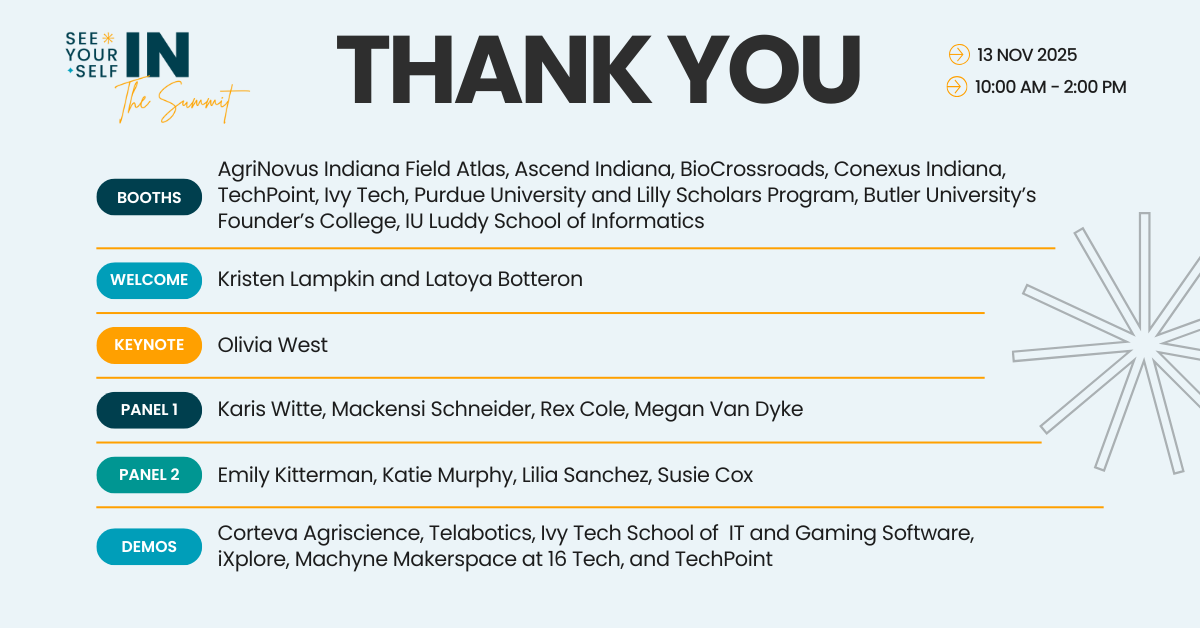
The 2025 See Yourself IN High School Summit brought together hundreds of high school students, educators, and industry leaders for a day designed to spark possibility and illuminate real pathways into Indiana’s advanced industries. From the moment students arrived at the AMP at 16 Tech on November 13, the energy was unmistakable: curiosity, excitement, and a genuine eagerness to explore what’s possible for their futures.
Learning from the Leaders Who Shape Indiana’s Economy
We kicked off the 2025 See Yourself IN Summit with an opening from Kristen Lampkin and Latoya Botteron of CICP, who encouraged students to think boldly about their futures and to go into this day with an open mind of what is out there in Indiana.
We then welcomed Olivia West, in-game host for the Indiana Fever and Indiana Pacers, to the stage, where she shared an inspiring keynote about the importance of values – our GPS system – and how those values lead us toward decisions that affect our future. She inspired all of us to think big and to stay curious, both at the summit and in life.
Across the Summit, speakers from CICP’s branded initiatives and partners — TechPoint, AgriNovus, BioCrossroads, Conexus Indiana, and Ascend Indiana — shared insights into the future of work and the incredible opportunities emerging in technology, life sciences, agbiosciences, advanced manufacturing and logistics, and beyond. They were also able to share opportunities for students to get plugged in and get a jumpstart on their careers, whatever that path may be.
The morning session ended with two valuable panel discussions that exposed students to real stories of success and validation that it’s okay to not know your next step. We first welcomed a group of current students who are tied to CICP’s various talent programs, including Field Atlas, Xtern, and the Modern Apprenticeship Program (MAP). These individuals – Mackensi Schneider, Megan Van Dyke, and Rex Cole – were joined by AgriNovus Indiana Career Success Manager Karis Witte to discuss their respective programs as well as their advice for students who may be interested in following in their footsteps.
We then transitioned to a panel of early-in-career professionals who have been able to make an impact and find success (and their voice) in various advanced industry careers. Susie Cox, an Automation Leader at Corteva Agriscience, Katie Murphy, a Manufacturing Engineer at Arcamed, and Lilia Sanchez, a Postdoctoral Fellow at Indiana Biosciences Research Institute joined moderator Emily Kitterman, Director of Careers in Tech at TechPoint on the stage. These individuals were able to share advice to students about finding their path and ways to find success in the advanced industries, as well as offered some perspective on what the “advanced industries” really mean and why they are so important, not just to our state but to our world.
Beyond the stage, the Summit’s industry activations transformed career exploration into something students could touch, test, and experience. From learning about life sciences through VR to extracting strawberry DNA, coding alongside tech mentors to learning about how to use AI, students had a chance to see these advanced industries come to life in very tangible ways. A special thanks to the following groups who volunteered their time and talent to provide these hands-on demos to our students:
Corteva Agriscience: Strawberry DNA Extraction
EMC2 – Facility and Lab Tour
Ivy Tech School of IT and Gaming: Coding Activity
iXplore: Virtual Reality Experience
Machyne at 16 Tech – Tour of Machyne Makerspace and Welding Demo
Telabotics: Robotics Demonstration and Activity
TechPoint – AI Workshop
Many students were eager to share that this was their favorite part of the day, the moment careers felt tangible, accessible, and exciting.
In addition to these hands-on activities, we had several partners who set up booths at the AMP where students could learn about opportunities to take the next step. Butler University’s Founder’s College, IU Indianapolis, Purdue University, Ivy Tech, and each of our branded initiatives – Ascend Indiana, AgriNovus Indiana, BioCrossroads, Conexus Indiana, and TechPoint were able to share opportunities for our high school students to get plugged in and turn today’s excitement into an actionable step forward.
Student Takeaways and Outcomes
Throughout the day, one message came through clearly: There is a place for every student to see themselves IN Indiana’s innovation economy.
As students got their ice cream and headed home for the day, they left with an idea of their values, a new awareness of growing career paths and opportunities, direct connections to mentors, employers, and continuing education, and insights into the skills needed for today’s (and tomorrow’s) jobs.
Perhaps most importantly, they left with a greater understanding that their strengths, interests, and values can help shape their decision-making and influence their path to a fulfilling career, right here in Indiana.
The learning doesn’t stop when the Summit ends. Students, families, and educators can continue exploring resources, career pathways, and videos throughout the year at SeeYourselfIN.com.
A Community Coming Together for Students
None of this would have been possible without our incredible network of partners:
Panelists and speakers who generously shared their time and stories
Exhibitors and activation partners who brought advanced industries to life through hands-on demonstrations
Educators and school leaders who championed their students and made participation possible
CICP’s five branded initiatives who collaborated to create a seamless, meaningful experience for students across the state
This collective effort is what makes the See Yourself IN Summit so powerful. It represents the very best of Indiana’s commitment to developing its future talent.
For Bryce Maxwell, ‘25, the decision to attend Indiana State University was rooted in family and practicality. Born and raised in Terre Haute, Maxwell chose to pursue a degree from Indiana State because of stories he had heard from family members.
“My mom, my dad, and my older brother all went to Indiana State,” he shares. “I had three great examples of success stories, so I thought I’d stay in my hometown. The tuition was great, and I knew Indiana State was a nice school. I could find my way and figure out what I wanted to do.”
Finding that way, however, took time. Maxwell entered college unsure of his future career plans, initially majoring in finance. “I knew I liked numbers, so I thought, ‘What do numbers go into? Finance,’” he says. It wasn’t until he discovered the business analytics minor—and the mentorship of Dr. Concetta DePaolo—that his path began to take shape.
“I was sitting in her class one day and realized I enjoyed it a lot more than my finance classes,” he recalls. “She showed me how analytics overlapped with supply chain, and that same day, I switched my major.”
Switching majors late could have been challenging, but Maxwell found the supply chain management program to be a welcoming, supportive environment. He quickly built connections with faculty and peers, and through collaborative projects, he gained confidence that he had made the right decision.
“I had no idea what supply chain management was,” he admits. “But supply chain management is in every business. It follows products through the whole production line, and there’s so much you can do.”
When asked what he enjoys most about his major, Maxwell struggles to pick just one thing. “I really enjoy all of it. There are so many parts to supply chain management that once you find a part you like, you can have a completely different experience than someone else. There are so many opportunities and routes you can go down.”
Mentorship played a pivotal role in Maxwell’s Sycamore journey. He credits Dr. DePaolo for her guidance and support, recalling how she spent an hour with him discussing career paths and helping him make the switch from finance to supply chain management. “My favorite class was solving with Excel sheets – taking real-world situations and optimizing them, saving companies money,” he says.
That academic preparation paid off during an internship at Cummins, Inc., in Columbus, Indiana. At Cummins, a global leader in power generation products, Maxwell worked in supply chain planning and analytics – helping set up a new engine line and ensuring all parts were brought in properly. That internship experience led to a full-time job offer after graduation in December.
Maxwell credits Indiana State’s curriculum for preparing him well, especially with its emphasis on analytics and real-world problem-solving. “I felt like from day one, I had a better grasp on what we were doing,” he says. “The real-world examples we worked on in class taught me to think quickly, problem-solve, and adapt – skills that are crucial in supply chain.”
Outside his major, Maxwell found community through club volleyball, playing all four years and forming friendships across the University. “Joining that club took up a lot of time, but it was definitely worth it. I made friends I never would have met otherwise,” he shares.
He describes Indiana State as a community that truly invests in its students’ success – both during college and beyond. His advice to future Sycamores is simple: take advantage of every opportunity.
“Attend networking events, career fairs, and speaker sessions,” he says. “Even if you never talk to someone again, you never know where a conversation might lead. Build your network, build your skills, and be open to learning.”
As Maxwell prepares to graduate and begin his career at Cummins, he reflects with gratitude for the mentors, friendships, and experiences that shaped his Sycamore journey at Indiana State.
“Indiana State cares a lot about its students. Professors give you countless opportunities to learn and grow. They want you to leave here ready to succeed.”
When Eric Wildeman was wrapping up his degree in public relations, advertising and applied communication at the University of Southern Indiana, he didn’t know what he wanted to do next. So, he interviewed with a variety of organizations, one of which happened to be a logistics firm. But it wasn’t what the company did that won him over. It was the way the company did it.
“It was more of the atmosphere that intrigued me,” he says. “It was a true sales floor. Everyone’s on the phone talking out loud, thinking out loud. It reminded me of a mini Wall Street.”
That was half-a-dozen years ago. Now a business development representative at Evansville’s PFL Logistics – which takes care of warehousing and transporting goods for companies – Eric says he continues to get a rush from the high-energy, fast-paced logistics environment.
Days go by quickly, he says, as he helps customers meet their needs and solve problems. For example, he recently helped a customer with a refrigerated product after the delivery truck was turned away at its destination. As scheduled, the shipment was picked up on a Thursday and delivered by 9 a.m. on Friday, but the receiving dock wouldn’t allow it to unload. Keeping the product refrigerated while waiting for a later delivery slot would cost the client a lot of money, Eric says, so he went into action. Juggling phone calls, pulling together documentation and aligning everyone’s objectives, he got the truck a delivery slot before things got too heated.
It was an achievement that leaned a lot on attributes Eric says are important to his job: problem-solving, communicating clearly and frankly, and managing your time while responding to multiple clients’ needs. Eric credits his family upbringing with giving him a work ethic that allows him to enjoy such challenges, along with an ability to communicate with people with varying roles – from the accounting office to the warehouse floor.
It helps that he gets to do this work in familiar territory. The Evansville native is happy that he found a job that allows him to settle with his wife in his hometown, where he now helps to coach the football team at his alma mater, Mater Dei High School.
Despite stumbling into logistics, Eric says he couldn’t imagine doing anything else. He loves the energy at PFL and in his industry. “It’s something different every day,” he says. “You never do the same thing all day or every day … it’s definitely what I was looking for.”